

What to Do With a Sloped Backyard: 9 Smart Solutions
From terracing and retaining walls to drainage, planting, paths and outdoor living, here are 9 practical ways to make a sloped backyard safer and more usable.

There is no single right answer for what to do with a sloped backyard, because the right solution depends on the problem you are actually trying to solve. If the issue is unusable space, terracing or a deck may be the answer. If the issue is runoff and erosion, drainage and planting come first. If access is the problem, steps and paths matter more than any retaining structure. Most sloped yards benefit from a combination of solutions rather than one big fix, and some need very little intervention at all. The table below pairs common slope problems with the solutions that typically address them.
| Problem or Goal | Likely Solution |
|---|---|
| Need usable level space | Terracing, retaining walls, deck or patio |
| Water runoff or soil erosion | Drainage improvements plus stabilizing planting |
| Difficult or unsafe access | Steps, paths, switchbacks and landings |
| Hard-to-mow lawn on a hill | Groundcover, native planting or hardscape |
| Want space for entertaining | Terraced outdoor living zones, deck or patio |
| Want the least intervention | Preserve and stabilize the natural slope |
Start by Deciding What You Need the Slope to Do
Before comparing materials, plants or contractors, get clear on what the slope needs to accomplish. A stable but useless slope is a design problem. A slope that sheds water toward the house is a drainage problem. A slope you cannot safely walk down is an access problem. Each points toward a different solution, and misreading the problem is how homeowners end up paying for the wrong fix.
Create Usable Space
If the goal is more room for seating, play, gardening or everyday use, you are really asking for level ground. That usually means reshaping part of the yard with terraces or retaining structures, or building above the grade with a deck.
Control Water and Erosion
If soil washes downhill after storms, bare patches keep spreading, or water runs toward the foundation, water management has to come before any cosmetic work. Vegetation, grading and drainage features address the cause; decorative landscaping on top of an active erosion problem rarely survives.
Improve Access and Reduce Maintenance
Sometimes the slope is fine as a slope, but it is awkward to move through or painful to maintain. In those cases, better circulation, tougher planting or converting lawn to lower-maintenance groundcover may solve the real problem without any heavy construction.
1. Terrace the Slope to Create Usable Levels
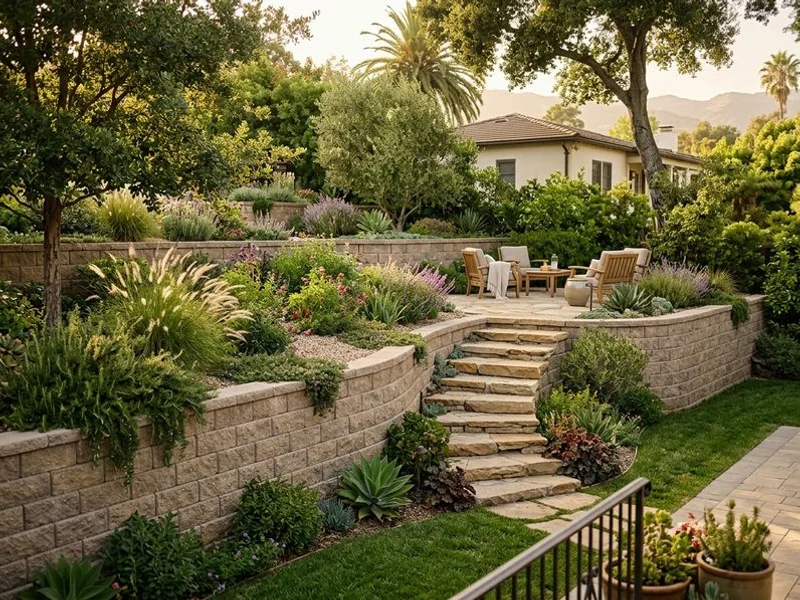
Terracing breaks one long grade into a series of smaller, flatter levels. Instead of flattening the whole yard, you create two or three usable platforms held by low walls, edging or planted banks, with steps connecting them. Each level can serve a different purpose: a dining terrace near the house, a planting bed or vegetable garden in the middle, a seating area at the bottom.
Terracing is often preferable to full leveling. The steeper and longer the slope, the more soil must move to create one flat plane, and the taller the single retaining structure at its edge becomes. Splitting the grade change across several smaller terraces usually means less excavation, lower walls and a result that sits more naturally in the landscape. Terraced gardens also slow water moving downhill, because each level intercepts runoff that would otherwise accelerate across one continuous surface.
2. Use Retaining Walls Where the Grade Needs Support
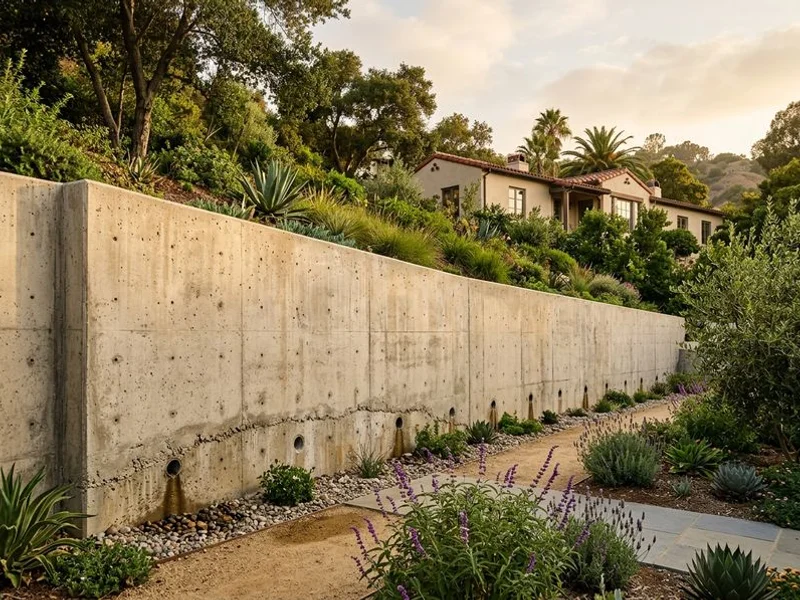
Retaining walls are the structural tool in the slope toolkit. Where a grade change has to happen in a short horizontal distance, a wall holds the upper soil in place and creates level, usable ground above or below. Walls can frame a patio, carve a flat lawn panel out of a hillside, support a terraced garden, or manage the transition to a higher or lower neighboring grade.
Walls also integrate well with the rest of the yard. A retaining wall can double as patio seating, define raised planting beds, or form the edge of an outdoor living area, with stairs built into the structure to connect levels. Because walls are structural elements, their height, placement and construction are regulated in many jurisdictions, and taller walls may require engineering and permits. Those details vary by location, so treat this as an overview of what walls can accomplish rather than a design guide.
3. Add a Deck or Patio for Level Outdoor Living Space

A deck or patio creates level, usable outdoor living space without flattening the yard. The two solve the problem differently. A deck builds a level surface above the sloping ground on posts and framing, which makes it well suited to steeper sites and yards where the best views are elevated. A patio sits on grade, so it needs a properly prepared level area, which usually means a cut-and-fill pad, a retaining edge, or a spot at the top or bottom of the slope where the ground is already close to flat.
Either approach can anchor seating, dining and entertaining areas. Decks work with changing elevation rather than against it, and multi-level decks can step down a gentle slope the way terraces do. Patios pair naturally with retaining walls, since the wall that creates the level pad can also define the space. Site access matters for both: if equipment cannot reach the build area easily, complexity climbs quickly.
4. Build Steps and Paths for Safer Access

A sloped backyard that is hard to move through will not get used, no matter how good it looks. Steps and paths turn an awkward hillside into connected, navigable space. Straight stair runs suit shorter grade changes, while switchback paths trade a direct line for a gentler climb on longer or steeper slopes. Landings break up long ascents, provide resting points and mark transitions between levels.
Circulation should be designed as part of the landscape rather than added later. A path that connects the patio, the garden terrace and the lower lawn makes every other improvement more useful. Materials range from natural stone steps and gravel paths to pavers or concrete, chosen to match the yard and its foot traffic. On slopes used after dark, path lighting is a safety feature as much as an aesthetic one.
5. Plant the Slope to Reduce Maintenance and Stabilize Soil

Planting is one of the most effective slope-management strategies available, and university extension research backs it up. Vegetation protects soil in three ways: foliage intercepts rainfall before it strikes the ground, stems and plant litter slow surface water, and roots hold the upper soil together. Oklahoma State University Extension notes that runoff from vegetated ground is dramatically lower than from bare soil, and Virginia Cooperative Extension points to groundcovers on slopes as a direct erosion-control tool.
Choosing Plants for a Hillside
Deep-rooted and fibrous-rooted plants do the most stabilizing work. A layered mix of groundcovers at the surface, ornamental grasses and perennials in the middle, and shrubs for deeper structure outperforms a single-species planting, because each layer catches water and anchors soil at a different depth. Native plants are frequently recommended because they suit local rainfall and soil and usually need less irrigation once established. Avoid invasive spreaders, which extension services warn can escape into natural areas.
Replacing Difficult Lawn
Steep lawn is one of the highest-maintenance surfaces in a yard: hard to mow safely, difficult to water evenly, and prone to thin bare patches. Converting sloped lawn to groundcover, native grasses, mulch beds or terraced planting cuts mowing time and improves coverage. Where irrigation is needed to establish plants, drip lines or short repeated cycles soak into sloped soil better than one long watering that runs downhill.
6. Use Rock Gardens and Boulders on Difficult Areas
Some parts of a slope resist every conventional treatment: too rocky, too dry, too steep to mow, too shaded for lawn. Rock gardens and boulders turn those areas into features. A rock garden combines stone with drought-tolerant planting to create a low-maintenance zone that suits the terrain, while well-placed boulders add visual weight and make the landscape look like it belongs to the hillside.
Boulders can also play a modest functional role. Set into a slope and combined with planting, they help hold small areas of soil, define terraces and slow surface water. The caution worth stating plainly: decorative stone is not a substitute for engineering. Rocks and boulders dress and protect a stable slope, but they do not solve an unstable one. If the ground itself is moving, that is a structural question, not a landscaping one.
7. Create Outdoor Living Zones That Follow the Grade
The most successful sloped backyards treat elevation change as part of the design instead of a defect to remove. Different levels naturally suggest different uses: an upper deck or terrace that catches the view, a mid-level lawn panel or garden, a lower fire-pit area or dining patio tucked into the hillside. Zoning the yard this way gives each activity its own defined space and spreads outdoor living across the whole property rather than crowding everything next to the house.
This approach also tends to be more economical. Working with the grade limits how much soil has to move and how large the structures must be. Handled deliberately, elevation changes give a sloped yard more variety than a flat one, with distinct spaces for cooking, eating, relaxing and play.
8. Fix Drainage and Erosion Before Cosmetic Landscaping
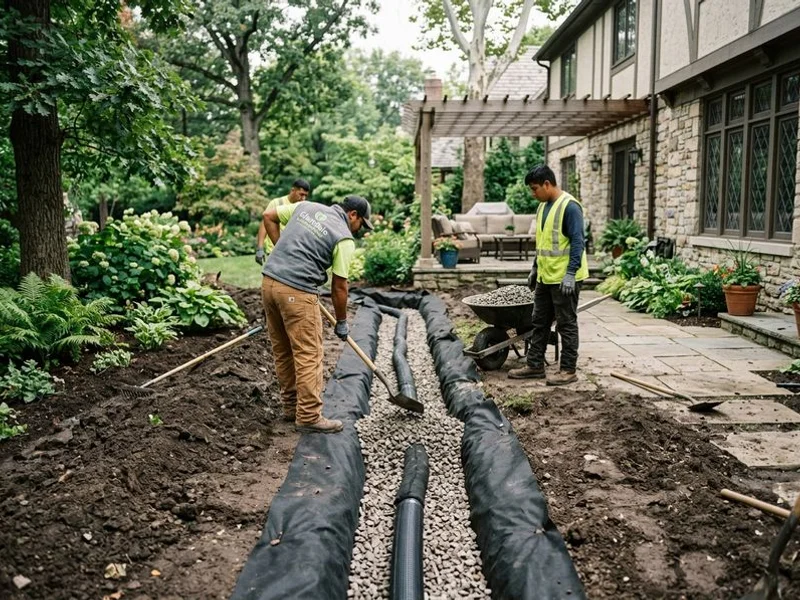
Water is the force behind most sloped-backyard problems. Rain falls on the slope, accelerates downhill, concentrates in channels, and carries soil with it. Left unmanaged, runoff erodes planting beds, undermines paths and patios, saturates the base of walls, and in the worst cases directs water toward the house. Iowa State University Extension advises reducing and redirecting surface water before and during hillside planting, treating soil cover and water diversion as the foundation of slope gardening rather than an extra.
The practical sequence matters. Address the source and path of water first: check where downspouts discharge, where runoff concentrates, and where soil is already washing out. Depending on the site, solutions range from reshaping surface drainage and adding swales that carry water safely downhill, to drains that capture concentrated flow, to erosion-control planting and mulch that protect exposed soil. What not to do matters just as much: planting or building on top of an active drainage problem usually means rebuilding within a few seasons. Site-specific drainage design should come from a professional assessment, because the right system depends on soil, slope and where the water needs to go.
9. Leave Part of the Slope Natural
Not every slope needs excavation, retaining walls or heavy construction. If a hillside is stable, drains reasonably well and does not need to become activity space, the lowest-impact option is often to preserve it. Stabilize what is there with groundcover and native planting, add a path if access is needed, and let the natural contours carry the design.
The restraint has real advantages. Undisturbed slopes keep their existing soil structure and established root systems, which already resist erosion, and construction stays confined to the parts of the yard that genuinely need usable space. Many of the strongest designs are a hybrid: intensive terracing and outdoor living near the house, softer naturalistic planting further out. Deciding what not to build is part of deciding what to do with the slope.
How to Choose the Right Solution for Your Sloped Backyard
With the options laid out, the decision comes down to a handful of site and lifestyle factors. Work through these before committing to any direction:
- Severity and shape of the slope. Gentle, even slopes support planting and path solutions; steeper or irregular terrain pushes toward terracing, walls or decks. The steeper the ground, the more likely structural work enters the picture.
- Soil and drainage behavior. Watch the yard during and after rain. Where water runs, ponds or erodes tells you whether drainage work must lead the project.
- Desired use. A yard meant for a play lawn, outdoor kitchen and vegetable garden needs more level area, and therefore more construction, than one meant mainly for low-maintenance planting.
- Access and maintenance. Consider how people and equipment will move through the yard, and how much upkeep you want. Lawn on a slope demands the most effort; established native planting, groundcover and hardscape demand the least.
- Budget and staging. Structural solutions cost more than planting. Terraces, walls and outdoor living zones can often be phased, with drainage and stabilization first and amenities later.
- Existing structures and boundaries. Patios, fences, neighboring grades and the house itself constrain where grade changes can safely happen.
Most projects combine several options: drainage first, then terracing or walls where level space is needed, then planting, paths and outdoor living to finish.
When a Sloped Backyard Needs Professional Assessment
Professional assessment is worth the cost when any of the following apply: erosion that keeps returning or is getting worse, visible ground movement such as new soil cracks or bulges at the base of the slope, retaining structures that lean or crack, water flowing toward the house or ponding against foundations, major grade changes or excavation, or structures close to a steep slope. The USGS lists tilting trees, fences and retaining walls, new ground cracks, and water appearing where a slope was previously dry as warning signs of potential slope movement that merit expert evaluation.
Permit and grading rules add another reason to involve professionals early. Requirements for retaining walls, grading and drainage work vary by jurisdiction, and hillside areas often carry additional regulations. Homeowners planning larger projects, such as coordinated landscaping in Pasadena involving grading, drainage, retaining structures and outdoor living on hillside lots, generally benefit from treating them as one integrated design-build project rather than a series of disconnected fixes. A qualified contractor or designer can sequence the work so drainage, structure and planting support each other instead of competing.
Frequently Asked Questions
How do you prevent erosion in a sloped backyard?
Erosion control starts with water. Redirect runoff from downspouts and hard surfaces so it does not concentrate on the slope, then cover bare soil. Vegetation is the most durable protection: groundcovers, grasses and shrubs intercept rain, slow surface flow and hold soil with their roots. Mulch and erosion-control blankets protect the surface while plants establish. Persistent erosion on steeper areas warrants a professional look at drainage and stability.
Can you build a patio on a sloped yard?
Yes, and it is one of the most common ways to reclaim a sloped yard. The patio itself must sit on a level, properly prepared surface, which usually means cutting a level pad into the slope, supporting the edge with a retaining wall, or locating the patio where the ground is already close to flat. On steeper sites, a deck that spans above the grade is sometimes the simpler way to get the same usable outdoor living space.
What plants work best on a slope?
Deep-rooted and fibrous-rooted plants do the most to stabilize soil. Groundcovers protect the surface, ornamental grasses and perennials add dense fibrous roots, and shrubs provide deeper structure. Native plants are a frequent extension-service recommendation because they suit local conditions and typically need less water and maintenance once established. A mixed, layered planting generally outperforms a single species. Avoid invasive spreaders, and check with your local extension office for species suited to your region.
Can a sloped backyard affect a home’s foundation?
It can, mainly through water. Slopes that direct runoff toward the house can saturate soil around foundations, and erosion can undermine soil supporting structures over time. Less commonly, slope movement itself can affect anything built on or below it. Warning signs include new cracks in the ground, soil pulling away from foundations, sticking doors and windows, and water ponding where it never did before. If you see these, have the property assessed rather than guessing.
What is the cheapest way to improve a sloped yard?
Planting is usually the lowest-cost improvement with real functional value. Converting difficult lawn to groundcover or native planting reduces maintenance and erosion at the same time, and mulch protects bare soil while plants fill in. Adding a simple path improves access without construction. Costs rise quickly once excavation, retaining walls, drainage systems or decks enter the plan, so the affordable strategy is to stabilize and plant first, then phase structural work only where level space is genuinely needed.
When should a professional assess a sloped backyard?
Bring in a professional when the project involves significant grade changes, retaining structures, drainage affecting the house, or any sign of slope movement. Recurring erosion, leaning walls or fences, new ground cracks and water problems near the foundation all justify assessment before spending on cosmetic work. Grading and retaining-wall permit rules vary by jurisdiction, so a professional familiar with local requirements can also prevent compliance problems.
External Sources
- Virginia Cooperative Extension: “Reducing Erosion and Runoff” (Publication 426-722). Groundcovers on slopes control erosion because roots hold soil and foliage softens raindrop impact.
- Iowa State University Extension: “Gardening on Slopes and Hillsides.” Terracing, soil cover, contour planting and redirecting surface water as the foundation of hillside gardening.
- Oklahoma State University Extension: “Using Vegetation for Erosion Control.” Vegetation intercepts rain, slows runoff and anchors soil; runoff from vegetated ground is far lower than from bare soil.
- USDA Natural Resources Conservation Service: “Vegetative Barriers for Erosion Control.” Plant barriers across a slope retard and disperse surface runoff and reduce soil loss.
- U.S. Geological Survey, Landslide Hazards Program: “What are the signs of landslide development?” Warning signs of potential slope movement, including tilting trees, fences and retaining walls, new ground cracks and water appearing where a slope was previously dry.
A free on-site consultation, a phased budget tier, and a master plan that fits your property and your goals.