

Paver Driveway Drainage Solutions
Explore paver driveway drainage solutions for standing water, poor slope, runoff and erosion, including grading, permeable pavers, drains and base repairs.

On this page
The right paver driveway drainage solutions depend on where the water comes from, where it collects and where it can safely go. Each approach has benefits and limits. Surface pooling often calls for regrading or a collection drain. Saturated soil may require subsurface drainage. A permeable paver system can infiltrate and store stormwater when its base, soil and overflow route are designed for that purpose. Start with the water path, not a product.
A channel drain across a garage can intercept surface flow. It cannot correct a saturated subgrade or a driveway with no available outlet. Likewise, permeable pavers are not simply regular pavers with wider joints. They are one part of a complete pavement and drainage system.
This guide explains how a paving contractor diagnoses standing water, runoff, erosion and poor drainage. It compares practical solutions for new installations and existing driveways. Homeowners can use it to prepare for a site visit and understand the scope before requesting a repair.
Drainage Problems and Likely Solutions at a Glance
| What you observe | Possible cause | Solution a contractor may evaluate |
|---|---|---|
| Water sits in one shallow depression | Local settlement or an isolated low paver area | Lift and reset pavers after correcting the bedding or base below |
| Water flows toward the garage or house | Reverse grade or an entrance lower than the street | Regrade the pavement, add a properly drained channel drain or rebuild part of the section |
| A sheet of water crosses the driveway from a slope | Run-on from a roof, lawn, hillside or neighboring hardscape | Intercept or redirect the source with grading, a swale, drain or approved conveyance |
| Joint sand and soil wash onto the pavement | Concentrated runoff, poor edge restraint or unprotected landscaping | Reduce flow velocity, stabilize edges and correct the outlet and erosion source |
| Pavers rock and the area stays wet | Weak or saturated base, settlement or a leaking utility | Investigate the pavement layers and water source before resetting the surface |
| Water remains after a permeable installation | Clogged joint stone, sediment-laden run-on or an undersized system | Inspect surface infiltration, maintenance history, reservoir design and overflow |
| A drain is installed but pooling remains | Blocked grate or pipe, wrong inlet location or inadequate outlet | Check the complete flow path from contributing area to discharge point |
| The yard stays soggy beside the driveway | Slow-draining soil, subsurface flow or irrigation | Consider regrading, a French drain, vegetation control or another site-specific measure |
This table is a starting point. Several causes can occur together. For example, a low area may collect roof runoff and also have a settled base. Cleaning the puddle or adding more joint sand will not solve either cause.
Why Good Drainage Matters for a Paver Driveway
Concrete pavers themselves are durable units, but the driveway performs as a layered pavement. Water can affect the bedding, aggregate base, soil subgrade, joints and edge restraint. Persistent saturation may reduce support and contribute to settlement under vehicle loads. Moving pavers then create more low spots where water can collect.
Poor drainage also affects daily use. Standing water leaves dirt and debris on the surface. Damp shade can support mildew or moss. Concentrated flow can cause soil erosion along borders and wash joint material onto the paving. Water near a garage door or floor creates a more urgent water-damage risk.
The goal is not to make every property perfectly dry during an exceptional storm. The goal is a designed path for normal rainfall and a safe overflow path for larger events. Good drainage protects the pavement, surrounding landscape and curb appeal while reducing avoidable maintenance.
Diagnose the Drainage Problem Before Choosing a Fix
A professional assessment follows water from its source to its final outlet. This step prevents the most common drainage mistake: installing a device that collects water without having anywhere suitable to send it.
Observe the driveway during and after rain
When conditions are safe, observe light and heavy rain. Note where water enters the property. Watch whether it sheets across the surface, emerges near a border or flows from a downspout. Mark the perimeter of puddles. Note how many hours they remain after rain stops.
Photographs and short videos are useful. Take notes, and save a phone video of the water flow when possible. A dry-season inspection can miss a flow path that becomes obvious during winter rain. If observation is impossible, look for sediment lines, stained pavers, displaced mulch and erosion channels.
Do not enter deep or fast-moving water. Stay clear of traffic, electrical hazards, unstable slopes and contaminated runoff.
Trace every contributing water source
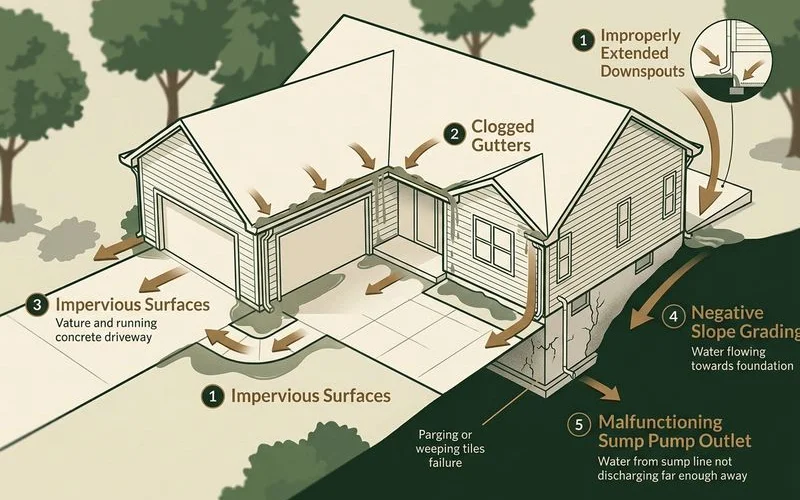
A driveway may receive much more than the rain falling directly on it. Common sources include:
- Roof gutter and downspout discharge.
- Runoff from an uphill lawn, patio, deck or neighboring pavement.
- Water flowing down the street apron toward the garage.
- Irrigation overspray or a broken sprinkler line.
- A leaking pipe or utility beneath the pavement.
- Subsurface water moving through soil toward a low area.
- Sediment-bearing flow from bare planting beds or construction areas.
The size of the contributing area matters. A roof can deliver a concentrated volume even when the driveway itself is modest. A small collection drain may be overwhelmed if several downspouts discharge immediately upstream.
Measure elevations instead of judging slope by eye
A paver surface can look flat while still having useful cross slope. It can also appear attractive while draining in the wrong direction. Contractors use levels, lasers or surveying equipment to establish high points, low points and fixed elevations.
Important references include the garage floor and door threshold, street apron, sidewalks, walkways, gates, steps, drains, utility covers and property boundaries. These points determine whether regrading is practical and how much elevation can change.
CMHA construction guidance for conventional interlocking concrete pavement gives a general minimum slope of 1.5%. That is not a promise that one number solves every retrofit. The actual design must work with fixed elevations, accessible routes, drainage outlets and site conditions. A long driveway may need both longitudinal slope and cross slope rather than a single straight tilt.
Check whether the surface problem is local or systemic
An isolated depression with stable surrounding pavers is different from a driveway that slopes toward the house along its full length. Local settlement may allow a targeted repair. A systemic reverse grade usually needs broader reconstruction or a separate interception strategy.
Look for rocking units, spreading edges, wide cracks in adjacent concrete and repeated settlement. These signs suggest that the cause extends below the visible paver surface. Simply adding bedding sand under a few units may leave the underlying water problem untouched.
Evaluate soil type and subsurface conditions
Soil type affects both support and infiltration. Sandy or gravelly soils often drain more readily than fine silt or clay, but actual field conditions vary. Fill soil, compaction, a high water table and buried hardpan can change the result.
A contractor may recommend field infiltration testing or engineering review for a proposed permeable system. A small home percolation test is not a complete hydrologic design. Infiltration rates, storage volume, vehicle loads and overflow all need to work together.
Slow soil drainage does not automatically rule out permeable pavement. It may change the design from full infiltration to partial infiltration with an underdrain, or to a lined detention system with a controlled outlet. Those are engineered assemblies, not a thicker layer of loose gravel.
Inspect the existing base and pavement layers
For recurring settlement or saturation, a small exploratory opening may be more useful than another surface repair. The contractor can examine the bedding, base material, fines contamination and soil condition. The opening also helps confirm whether a drain can be installed without undermining support.
Dense-graded base and open-graded drainage base serve different purposes. A conventional driveway commonly relies on compacted aggregate for structural support and surface grading for runoff. Permeable interlocking concrete pavement uses clean, open-graded stone in the joints and reservoir layers. Mixing the two approaches without a design can reduce either stability or drainage.
Identify a legal, functional outlet
Every collected flow needs a destination. Possible routes include an approved storm drain connection, a suitable vegetated area, a designed infiltration feature or another permitted discharge point. The right choice depends on local requirements and the receiving site.
Do not assume that a drain can empty into a sanitary sewer. Do not redirect concentrated runoff toward a neighbor, public walkway or unstable slope without approval. A grated inlet connected to a buried pipe with no outlet is only a temporary water container.
Los Angeles County drainage-review materials illustrate why site plans may need contributing areas, device sizes, elevations, inlets, outlets and roof-drainage details. Requirements vary by jurisdiction and project. Confirm them before excavation.
Know when engineering or utility review is needed
Seek qualified design help for flooding near a house foundation, retaining walls, steep slopes or major grade changes. Also get help for large contributing areas or repeated structural movement. The same applies when groundwater, a high water table or unstable soil is suspected.
Have utilities located before digging a trench, catch basin or dry well. Review possible contamination before infiltrating runoff from a spill-prone area. A drainage solution should never create a structural, environmental or safety problem elsewhere.
Proper Grading and Slope: The First Drainage Solution
Grading gives water a surface route without requiring a pump or a maze of buried pipes. On a new paver driveway drainage installation, it should be planned with the base and every fixed elevation. On an existing driveway, the available correction depends on how much height can change.
Design the finished elevations before excavation
Start with the points that cannot move. These often include the garage slab, street connection and adjacent walkway. Establish a finished paver grade that directs water away from structures and toward the intended collection or infiltration area.
The subgrade and base must follow the design rather than creating a level platform beneath a sloped paver surface. Bedding sand is not a material for correcting major base irregularities. CMHA warns that unevenness in the base can reflect through the finished pavement.
A broad driveway may need a crown, cross slope or several drainage planes. Use the natural grade where practical. The design should avoid concentrating water where pedestrians walk or where a vehicle entrance already sits low. Small swales and grade breaks can sometimes divide the flow into manageable routes.
Match the correction to the existing grade problem
For one settled area, a contractor may lift the pavers, remove unsuitable bedding, correct the base and reinstall the units at the proper elevation. This works only when the surrounding grades provide somewhere for water to go.
For a widespread low or reverse slope, a localized reset is not enough. The repair may require removing a larger section and rebuilding the subgrade and base. At a constrained garage entrance, a channel drain may be more practical than raising the entire driveway.
Adding a thin overlay to bury a low spot can create new height and support problems. It may also move the puddle rather than remove it. Have the complete assembly reviewed before choosing an overlay as a drainage correction.
Do not drill random weep holes
A hole through a paver or joint does not create a drainage system. Water still needs a lower receiving layer, capacity and a safe outlet. Random holes can weaken the surface appearance, admit sediment or saturate the base.
Weep paths should exist only where they belong to a designed assembly. The same rule applies to cutting a notch through edge restraint. A small opening can release water but also allow bedding loss and erosion if it is not detailed correctly.
Drainage Base Construction for Paver Driveways
Each base layer must support vehicles while working with the drainage plan. There is no single “best gravel” for every pavement. Material gradation, layer thickness, compaction, soil separation and water management depend on the system. Base composition must suit both support and drainage.
Conventional dense-graded base
A conventional interlocking concrete paver driveway usually uses compacted, dense-graded crushed aggregate over prepared soil. Surface slope carries most rainfall away. The base design responds to traffic, soil type, moisture and climate.
Geotextile fabric may separate weak or wet soil from aggregate and reduce soil migration into the base. It is not waterproofing, and it does not turn a poor subgrade into a structural design. Where used, the specified fabric, placement and overlap matter.
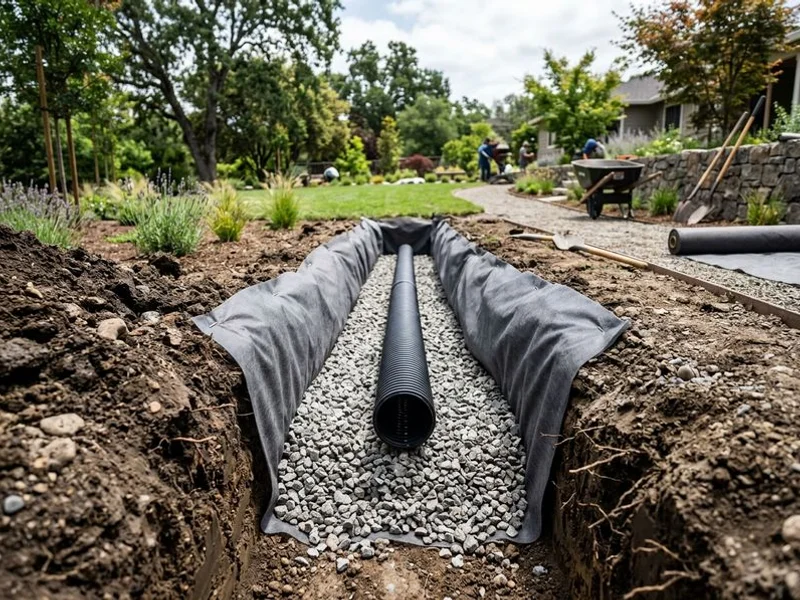
CMHA also describes perimeter subsurface drainage for slow-draining soils. A typical detail uses perforated pipe surrounded by open-graded stone and geotextile, with a sloped outlet. The project designer determines whether and how to use it. The pipe must remove water without creating a path for base or bedding loss.
Open-graded reservoir base for permeable pavement
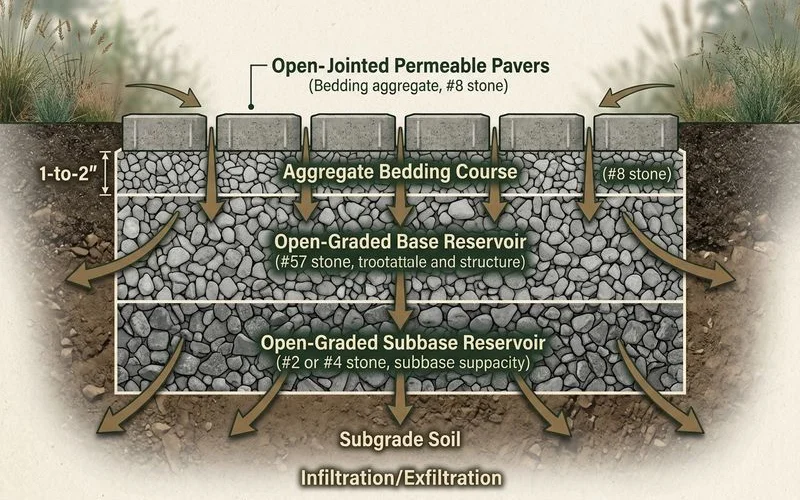
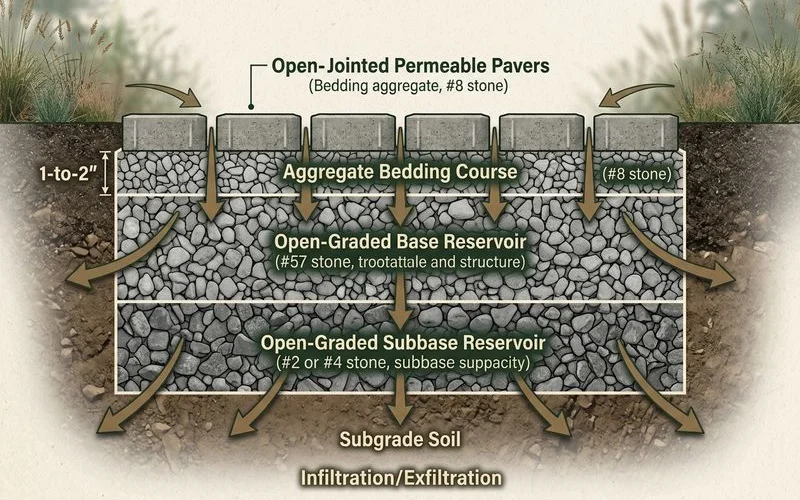
Permeable interlocking concrete pavement uses open-graded angular aggregate in the joints, bedding and reservoir layers. Void spaces between the stones provide temporary stormwater storage. Water may infiltrate into the subgrade, leave through underdrains or both.
These layers also support vehicles. Their thickness is governed by both structural and hydrologic design. Adding more stone without checking either function is not a professional solution.
Keep the stone clean during construction. Soil, mulch and sediment can fill the voids and reduce storage or infiltration. Adjacent disturbed soil should be stabilized before runoff reaches the permeable surface.
Why gravel alone is not a universal repair
Pouring gravel into a settled paver area may create a temporary bridge, but it does not establish stable support or a controlled outlet. Rounded decorative gravel is not automatically suitable as a structural drainage base. Fines, stone size and layer compatibility matter.
Likewise, a thin layer of gravel over clay is not a dry well. It may hold some water briefly, but it can still overflow toward the same low point. Define the required storage and discharge behavior before choosing the material.
Protect joints without confusing them with drains
Joint material helps paver interlock and can resist erosion, but it is not a substitute for grading or drainage. On conventional pavers, stabilized sand may reduce joint loss in suitable applications. Our guide to how to apply polymeric sand for a paver driveway explains that installation process.
Permeable systems are different. CMHA maintenance guidance states that PICP does not use sand jointing or bedding. Its joints use specified open-graded stone so water can enter. Do not seal those joints with polymeric sand in an attempt to stop weeds or erosion.
Permeable Pavers as a Driveway Drainage Solution
Permeable paver systems can improve surface drainage and reduce runoff while providing a finished vehicle surface. They work by moving water through open joints into a stone reservoir below. Unlike standard pavers, permeable units work with an open-graded reservoir. The system then infiltrates, detains or conveys the water according to its design.
Understand the three basic system types
- Full infiltration: Water passes through the reservoir and into suitable underlying soil. An overflow route is still needed for events beyond the design capacity.
- Partial infiltration: Some water enters the soil while underdrains convey excess flow to an approved outlet. This approach can suit lower-infiltration soils when designed correctly.
- No infiltration or lined detention: A liner separates the reservoir from the subgrade, and water leaves through a controlled outlet. This may be necessary where infiltration could affect structures, unstable soil or groundwater quality.
These options show why permeable pavement is not just a surface product. Two driveways can use similar pavers and behave very differently below grade.
Evaluate the site before choosing permeable construction
Review the contributing drainage area, infiltration rates, seasonal groundwater and nearby foundations. Check slopes, wells, utilities, soil permeability and vehicle loads. Vehicle weight also affects the structural design. Avoid locations where spills or hazardous materials could enter the soil through the pavement.
A permeable system may not be appropriate beside an unstable hillside or where added water could weaken a neighboring base. Liners, underdrains and separation details may manage some constraints. These features require an integrated, project-specific design.
Consider maintenance access as well. The owner must be willing to keep sediment, leaves and debris from accumulating in the joints. A hidden system with no inspection or overflow access is difficult to manage.
Permeable pavers are not the same as grass pavers
Concrete grid or grass pavers contain openings that may support grass or aggregate. They often suit intermittent parking or access uses rather than every daily-traffic driveway. Their base and load limits differ from PICP.
Porous pavements such as pervious concrete and porous asphalt are other permeable surfaces. They are alternatives to PICP, not versions of it. They are not interlocking paver systems and have their own construction requirements. Compare the complete assembly, appearance, maintenance and vehicle use rather than treating every porous surface as interchangeable.
Retrofitting an existing driveway requires excavation
A permeable paver installation on an existing conventional driveway normally means removing the existing surface and unsuitable base. The contractor then builds the designed reservoir, separation, underdrain, overflow and paver layers.
Replacing only the top pavers with permeable units will not create reservoir storage. Filling old joints with gravel will not turn a dense base into a permeable system. A true conversion can be a valuable solution, but it is reconstruction rather than a simple paver swap.
Maintain surface infiltration
Sweep or vacuum the surface using methods appropriate to the system. Remove sediment before it becomes compacted into the joint stone. Remove any weed growth without disturbing the stone. Maintain the joints with clean aggregate matching the original specification.
CMHA notes that some joint-stone settlement may occur early and require refilling. It also emphasizes controlling run-on from eroding soil, mulch and yard waste. If you notice a decline in surface infiltration, have the system inspected. Do not apply sealer or sand to the joints.
Provide access to underdrains, cleanouts and overflow points where the design includes them. A permeable surface can still overflow during an exceptional storm, so the safe excess-flow route must remain open.
Channel Drains and Trench Drains for Surface Runoff
A channel drain is a long, narrow inlet. This linear drain solution intercepts surface water along a line. A trench drain generally refers to the same type of linear system. The drainage channel sits flush with the finished surface and carries water through an outlet pipe.
Where a linear drain makes sense
Common locations include the garage entrance, the bottom of a sloped driveway and a transition where surface flow cannot be redirected by grading alone. A linear drain can intercept water before it reaches a door or another sensitive area.
The inlet must sit where water actually travels. A drain placed a short distance too high or too low can miss the main flow. Its length, outlet capacity and connection elevations must suit the contributing area and available discharge route.
A channel drain still needs an outlet
The visible grate is only the entrance. The channel allows water to move through the pipe to an approved destination. If the outlet is blocked, set too high or undersized, the drain can fill and allow pooling to continue.
Provide maintenance access and cleanouts where needed. Leaves, sediment and small stones can collect in the channel. A removable grate and accessible sump or basket make routine cleaning easier.
Select the channel and grate for vehicle use
Do not choose a residential drain by appearance alone. Verify the manufacturer’s load class, rating and installation detail. Check suitability for the expected tires and turning movements. The surrounding concrete or support material is part of the load-carrying detail.
Product bodies may use plastic, polyethylene, PVC, HDPE, polymer concrete, fiberglass or metal. A lightweight body still needs the right support and load rating. Grates may use galvanized steel, stainless steel or ductile iron, among other materials. A 304 stainless steel finish does not by itself prove that a grate is suitable for driveway loads. Check the complete rated assembly.
Micro channel and slot-style products can provide a discreet aesthetic, but a smaller opening may need more frequent debris removal. Balance appearance with hydraulic capacity and maintenance access.
What a channel drain cannot fix
A linear inlet does not dry a saturated base or correct ongoing settlement. It cannot intercept subsurface water unless the assembly is specifically designed to do so. It also may not solve a property-wide grading problem when water approaches from several directions.
If the pavement continues to sink beside the drain, investigate support and soil conditions. Repeatedly resetting the channel without correcting the cause can damage both the drain and pavers.
Catch Basins for Point Collection
A catch basin collects water at a specific low point rather than along a continuous line. A grate or drain cover admits surface flow. The basin then discharges through a pipe to the approved outlet.
Use catch basins in suitable low areas
A basin may serve a landscape edge, a paved low point or a location where several surface paths converge. It can be combined with a channel drain when line interception and point collection are both needed.
The rim elevation is critical. Set too high, water flows around the basin. Set too low without proper support, it can collect excessive sediment or create a surface hazard. CMHA guidance addresses the relationship between finished pavers and adjacent catch basins or drain channels; project tolerances and accessibility requirements still apply.
Plan for sediment and cleaning
Many basins provide a sump area below the outlet where some sediment can settle. A removable basket or strainer can capture leaves and debris. These features do not eliminate maintenance; they make it possible.
Inspect the basin after major storms and during leaf fall. Remove accumulated material before it reaches the outlet. If sediment buildup fills the basin repeatedly, correct the upstream erosion source. Do not rely on cleaning more often without limit.
Use solid conveyance after collection
Once surface water enters a basin, it normally travels through a solid outlet pipe. A perforated pipe is not a substitute for every conveyance run because it may release water along the route. Pipe material, diameter, slope, bedding and cleanouts should match the design.
Avoid creating a hidden low spot in the pipe where sediment can collect. Protect the outlet from blockage and discharge erosion. Preventing outlet damage is part of the design. Where gravity flow is impossible, a designed sump and pump system may be required, complete with a safe overflow or failure plan.
French Drains and Subsurface Drainage
A French drain collects and conveys water through a gravel-filled trench, commonly with perforated pipe. It is used for subsurface interception or for collecting water that can enter the gravel from above. It is not automatically the best paver drainage option for a sheet of water moving across pavers.
How a French drain works
Water enters clean gravel and moves toward the perforated pipe or through the designed trench section. The pipe conveys collected water toward an outlet. Geotextile may separate surrounding soil from the drainage aggregate to limit clogging when specified.
French drains can help with soggy soil beside a driveway or with subsurface water moving toward the pavement. CMHA also includes perforated perimeter drainage as an option for certain conventional pavement subgrades.
Distinguish a French drain from a surface drain
A buried French drain with soil over it may not intercept fast surface runoff before that water reaches the garage. A catch basin or channel drain provides a direct surface inlet. Some combined systems use a surface inlet connected to a larger drainage network. Each component has a defined job. A property may still need additional drainage for another source.
If water emerges from saturated soil, a subsurface drain may be appropriate. If the main issue is a reverse surface slope, grading or line interception usually comes first.
Design the trench and outlet as one system
Trench depth, width, aggregate, pipe and fabric depend on the water source, soil and required capacity. Avoid copying a universal dimension from a different property. A trench that is too shallow may miss the subsurface flow; one that is too deep near a structure can create other risks.
Maintain a continuous route to the outlet. Include access for inspection where needed. Keep excavation away from foundations, retaining walls and utilities unless a qualified design addresses those conditions.
Tree roots and fine soil can clog some systems. Do not assume that any landscape fabric or pipe sleeve prevents every blockage. Material selection and installation should reflect the actual soil and root environment. These choices affect system longevity.

Dry Wells, Swales and Rain Gardens
Collection is only useful if the receiving feature can manage the water. Several runoff-management options may fit a property, but each needs capacity and overflow planning.
Dry wells and infiltration features
A dry well or infiltration feature temporarily holds runoff so water can enter suitable surrounding soil. It is not a bottomless hole. Its volume, soil infiltration rate, setbacks and overflow route determine whether it can serve the contributing area.
Avoid placing infiltration where it could affect foundations, slopes, wells, utilities or neighboring property. Use pretreatment or sediment control where needed so debris does not quickly fill the feature. Obtain the required approvals before connecting a driveway drain.
Vegetated swales and surface dispersion
A shallow swale can guide runoff along a vegetated path at a controlled grade. It may also spread and slow flow before a receiving area. Stabilize the surface so the swale itself does not become an erosion channel.
A swale needs space and a safe endpoint. Directing water into narrow side yards without enough grade or capacity can simply move the pooling problem.
Rain gardens and bioretention
A rain garden or bioretention area is a designed landscape feature that receives and treats suitable runoff. It is not merely a planting bed at the lowest point. Soil media, plants, ponding depth, underdrain and overflow depend on the design.
Keep roof and driveway runoff away from unsuitable slopes and foundations. Check local guidance before adding an infiltration feature. In Southern California, dry periods also require plant choices that can tolerate both the expected watering regime and periodic inundation.
Manage Roof, Landscape and Street Runoff
The least complicated drainage solution may be reducing the water reaching the driveway. Start with controllable sources before building a larger underground network.
Correct downspout and gutter discharge
Keep gutters and downspouts clear so roof rainwater goes to the intended discharge point. If a downspout empties beside the driveway, evaluate an extension or connection to an approved drainage system. Do not dump the flow at the base of a wall or onto an eroding slope.
A downspout extension that ends in the middle of a lawn may still send water back toward the pavement. Check the entire route during rain. The discharge area needs capacity, stable ground and a safe overflow path.
Stabilize soil and planting areas
Good landscape designs keep lawns and planting beds from shedding soil onto the pavement. Mulch, bare soil and landscape debris can wash onto conventional and permeable pavers. Regrade planting beds where practical, maintain healthy ground cover and use suitable edging that does not trap water against the driveway.
Avoid piling soil or mulch above the paver elevation. Keep irrigation off the driveway. Water planting areas without continuously spraying the pavement. Repair leaks and adjust run times to reduce unnecessary saturation.
Address street and apron flow carefully
A driveway below the adjacent street can receive road runoff during intense rain. Solutions may involve an apron drain, changed driveway grades or coordination with work near the public right-of-way. These changes can require local approval.
Do not build a hump or channel that pushes water into traffic, onto a sidewalk or toward a neighbor. Street-connected drainage and pavement elevations need a coordinated design.
Choosing a Drainage Solution for New and Existing Driveways
The best design integrates drainage before the pavers are installed. Existing driveways offer fewer elevation options, but they can often be repaired without replacing everything. Use the comparison below to discuss scope with drainage contractors.
| Drainage problem | During a new installation | On an existing driveway |
|---|---|---|
| General surface runoff | Establish finished slopes and drainage planes before building the base | Measure whether selective resetting or broader regrading can restore a useful path |
| Water toward the garage | Set the driveway and apron elevations to avoid reverse flow where feasible | Add a drained channel at the interception point or reconstruct the approach when required |
| Slow-draining surrounding soil | Evaluate subgrade drainage, soil separation and the appropriate pavement system | Inspect the base and consider perimeter subsurface drainage or another site-specific correction |
| Desire to reduce runoff | Design PICP reservoir storage, infiltration, underdrains and overflow as one system | Excavate and rebuild if converting to a true permeable assembly |
| A concentrated low point | Place a catch basin or inlet at the designed collection elevation | Install a basin only if a gravity or pumped outlet and maintenance access can be provided |
| Roof or landscape run-on | Route downspouts and stabilize contributing areas before final paving | Redirect controllable sources and repair erosion before enlarging the driveway drain network |
| Edge and joint erosion | Coordinate edge restraint, surface flow and stable landscape elevations | Restore support and restraint after correcting the water path; refill joints with the correct material |
Ask these questions before approving a proposal
Ask each question before work begins. Clear answers help define the job.
- What water source and contributing area is the design addressing?
- Is the main issue surface runoff, subsurface water, a structural low spot or several combined problems?
- Which elevations will change, and how will the garage and street connections be protected?
- Where does the water discharge, and is that outlet approved and accessible?
- How is pipe or storage capacity being selected?
- What happens during a storm larger than the design event?
- Which parts need cleaning, inspection or periodic replacement?
- Will existing pavers and base material be reused, and under what conditions?
- Are utility locations, permits and engineering review included where necessary?
- Which work is excluded, especially landscaping restoration and downstream drainage repairs?
Compare paver driveway drainage services by scope rather than by the number of devices in a quote.
Paver Driveway Drainage Repair: Typical Professional Approaches
Resetting a localized low area
The contractor lifts the affected pavers and examines the bedding and base. Unsuitable or contaminated material is removed as needed. Support is restored, elevations are corrected and the pavers are reinstalled with suitable joint material.
This repair suits an isolated problem with a working downstream drainage path. It is not enough when the full driveway drains toward a building.
Regrading a larger pavement section
For widespread reverse slope or several connected depressions, a larger area may need removal. The subgrade and base are rebuilt to the planned elevations before the pavers are reinstalled.
The scope can extend to the apron or garage approach because those fixed points control the water path. Expect the contractor to explain where new grades will tie into existing surfaces.
Adding a collection drain
The crew verifies the flow line, inlet elevation, outlet route and utility conflicts before cutting the pavement. The drain body and surrounding support are installed to suit vehicle loads. The outlet pipe is connected and access for cleaning is provided.
A final water test can check collection and discharge, but it does not replace structural inspection. The repaired paver edges should remain stable under traffic.
Rebuilding with permeable construction
A full paver driveway drainage replacement may involve rebuilding with permeable construction. That work includes excavation, reservoir layers and any specified liners or underdrains. Clean aggregate and sediment protection are essential. The overflow and maintenance plan are completed before the surface receives runoff.
This option may address both pavement replacement and stormwater goals. It is usually a larger project than adding a local surface drain.
Common Driveway Drainage Mistakes to Avoid
| Mistake | Why it fails |
|---|---|
| Buying a drain before tracing the water source | The inlet may address the wrong flow path or miss the main problem |
| Installing an inlet without a verified outlet | Collected water has nowhere reliable to go |
| Assuming gravel always improves drainage | Gradation, support, storage and soil conditions determine performance |
| Using polymeric sand in permeable paver joints | It can block the open joint function intended for surface infiltration |
| Resetting pavers without correcting the base | Settlement and pooling can return under traffic |
| Treating geotextile as waterproofing | Separation fabric does not replace drainage design or structural support |
| Choosing a grate only for color or finish | Vehicle load rating and the support detail may be unsuitable |
| Discharging toward a neighbor or sidewalk | The repair can create a new hazard, dispute or code issue |
| Ignoring roof and irrigation runoff | Controllable sources can overwhelm or continually wet the pavement |
| Sealing or sanding over a drainage symptom | Surface appearance changes while the water path remains defective |
| Omitting cleanouts and maintenance access | A blockage becomes difficult to locate and correct |
| Forgetting overflow for major storms | Water can back up toward structures when design capacity is exceeded |
Paver Driveway Drainage Maintenance Checklist
Routine care preserves conventional and permeable drainage systems. Keep drainage channels and inlets accessible. The exact schedule depends on trees, sediment sources and site use.
| When | What to inspect or do |
|---|---|
| Monthly during active leaf or debris seasons | Clear grates, drain covers and visible channel openings; sweep sediment from pavers |
| After significant rain | Note pooling locations, check outlets and look for erosion or displaced joint material |
| Before the winter-rain season | Clean catch basins and channels, check downspouts and confirm that overflow routes are open |
| Around irrigation adjustments | Look for overspray, leaks and persistently wet soil near the pavement |
| During routine paver care | Monitor low spots, rocking units, edge movement and changes in surface infiltration |
| For permeable pavement | Keep joints filled with the specified clean stone and use appropriate vacuum maintenance when needed |
| After landscaping or construction | Remove soil and mulch run-on and stabilize disturbed contributing areas |
Keep a simple record of cleaning and observed problems. A puddle that appears later each year or takes longer to drain is a warning sign. It deserves investigation. Do not wait for repeated water damage before checking the system.
What Affects Drainage Solution Cost?
Drainage pricing depends more on diagnosis and access than on the visible grate or basin. Set a budget for the full water path, not just the inlet. Important cost factors include:
- The length and depth of excavation.
- Whether pavers can be lifted and reused.
- The amount of base or subgrade reconstruction.
- Pipe length, fittings, cleanouts and outlet construction.
- Vehicle-rated channel and grate requirements.
- Soil disposal, utility conflicts and site access.
- Engineering, permits and inspections where required.
- Permeable reservoir depth, liners, underdrains and overflow.
- Landscape, concrete or hardscape restoration.
- Ongoing maintenance access and future repair needs.
A low price for an inlet alone may omit the outlet and restoration that make it work. An expensive grate does not guarantee a working system. Compare the complete drainage solution, including where the water goes and who maintains it.
Frequently Asked Questions
Each question below addresses a common homeowner decision. Use these FAQs to prepare for a site assessment.
Do ordinary concrete pavers help with drainage?
Ordinary concrete pavers can shed water effectively when the finished surface has the right slope. The same logic applies to patios. A paver patio has different load and elevation constraints. The joints may admit a small amount of water. A conventional installation is not designed to drain the whole driveway through its joints. Its compacted base is built mainly for support, while grading carries most rainfall away.
If water already moves toward a garage or collects over a weak base, replacing the driveway pavers alone will not correct the route. The contractor needs to address the elevations, base condition and outlet. True permeable construction is different because its joints, bedding and reservoir layers are all designed to pass or store water.
What is the best drainage solution for a paver driveway?
There is no single best drainage solution for every property. Different drain solutions perform different jobs. Regrading often makes sense when the surface lacks a useful slope. A channel drain can intercept a concentrated flow line at a garage approach. A catch basin can serve a defined low point. A French drain may suit subsurface water or soggy soil beside the pavement.
A permeable paver system can reduce runoff when the soil, reservoir, structural design and overflow support that goal. Some sites need a combination of these methods. The best paver drainage solutions address the actual water source. They deliver flow to a legal, functional destination without creating a new problem. A drainage service should explain both parts of that plan.
How much slope does a paver driveway need?
CMHA gives a general minimum slope of 1.5% for conventional interlocking concrete pavement. That equals about 1.5 units of vertical fall over 100 units of horizontal distance. It is a starting design reference, not a universal field instruction for every property or repair.
A driveway may need cross slope, longitudinal slope or more than one drainage plane. Garage slabs, steps, gates, sidewalks and street connections can limit the available grade. An accessible route may have additional requirements. Have a contractor measure the actual elevations rather than applying one percentage without checking where the water will go.
Why is water pooling on my driveway after it rains?
Water pooling usually means that the surface has a low area, the driveway slopes in the wrong direction or an inlet cannot discharge properly. Roof runoff, lawn run-on and irrigation can add more water than the pavement can carry. Settlement may also change a once-functional grade into a puddle.
Other causes include a blocked channel, a catch basin set at the wrong elevation, saturated soil or a base that has lost support. Watch the location and duration of the pooling. Photos during rain and after the storm help a professional distinguish a surface low spot from a larger drainage or structural issue.
How do I fix a driveway that puddles?
Start by identifying whether the puddle is isolated or part of a general reverse grade. That answer guides the paver driveway drainage solution. An isolated depression may be repaired by lifting the pavers, correcting unsuitable bedding or base material and resetting the units. The surrounding surface still needs a lower route where water can escape.
Widespread ponding may require regrading a larger section. At a constrained entrance, a drained channel may intercept the flow. If soil remains saturated or pavers keep moving, investigate the subsurface conditions before another surface reset. Adding sand on top, drilling random holes or pouring gravel into the puddle does not create a complete drainage system.
Can you install a drain in an existing paver driveway?
Yes, an existing driveway can often accept a channel drain or catch basin. Excavation must be planned around the base, utilities and fixed elevations. A paver driveway drain needs a sound support detail suited to vehicle traffic. The inlet has to meet the actual flow line.
Most importantly, the project needs a workable outlet and cleaning access. Cutting a trench through pavers is only part of the job. The scope may include base repairs, solid conveyance pipe, cleanouts, outlet protection and paver restoration. If those elements are not feasible, regrading or source control may be the better approach.
Do I need a channel drain on my driveway?
You may need one when surface runoff crosses a defined line toward a garage, doorway or other sensitive area and grading cannot redirect it reliably. A channel drain is especially useful at a low garage approach or a transition between hard surfaces. It intercepts flow along its length rather than waiting for water to reach one point.
You may not need one if a modest grade correction, downspout change or landscape repair removes the problem. A channel is also the wrong sole treatment for a saturated base or recurring settlement. Ask to see the flow path and outlet in the proposal before approving the installation.
When does a French drain make more sense than a surface drain?
A French drain makes more sense when water is moving through soil or collecting where it can enter a gravel trench. It may help a wet landscape edge or suitable subsurface condition beside a driveway. Perforated pipe and drainage aggregate can then collect and convey that water toward an outlet.
A surface drain makes more sense when runoff is moving visibly across the pavement. A buried gravel trench may not capture that flow quickly enough to protect a garage. Some properties need both kinds of collection. Solid pipe is normally used after a surface inlet when water must travel without leaking along the route.
Do permeable pavers replace a French drain or channel drain?
Not automatically. Permeable pavers manage rainfall that reaches their surface and any additional run-on included in the design. They do not guarantee collection of every subsurface flow or every concentrated stream from a roof, street or uphill property. Those sources may still need separate interception and conveyance.
The design also has to account for soil infiltration, reservoir capacity and major-storm overflow. On some sites, a permeable system works with underdrains or an approved outlet rather than replacing every drain. On others, grading and a simple collection inlet are more practical. Compare complete systems instead of treating one product as universal.
What should go under pavers for proper drainage?
For a conventional driveway, the assembly commonly includes prepared subgrade, compacted dense-graded aggregate base, bedding sand and concrete pavers. Geotextile may provide soil separation where specified. Finished surface slope remains essential because the conventional base is not intended to serve as an unlimited reservoir.
For permeable interlocking concrete pavement, the joints, bedding and reservoir use specified open-graded aggregate. The design may include underdrains, a liner, separation layers and an overflow route. Layer materials and depths depend on vehicle loads, soil and hydrologic requirements. The correct answer is therefore a designed base system, not one universal gravel product.
Is gravel alone enough to fix driveway drainage?
Gravel alone is rarely a complete repair. It can provide storage, convey water or support a pavement when the correct gradation is installed at the correct depth. It cannot decide where the water should go. Loose stone placed over clay or inside a depression may simply fill and overflow.
A working design defines the water source, required capacity and final outlet. It also separates structural base requirements from drainage requirements. Decorative pea gravel, a thin stone layer and an engineered open-graded reservoir are not interchangeable. Use gravel as one component of a system rather than as a universal cure.
What is the best driveway drainage solution for clay soil?
Clay soil often drains slowly, so the design should not assume rapid infiltration. Surface grading and reliable conveyance may do most of the work. A catch basin, channel drain or swale may help if it has a suitable outlet. Subsurface drainage may also be evaluated for a persistent saturation problem.
Permeable pavement can still be possible with partial infiltration and underdrains, or with a lined reservoir and controlled discharge. Those options require structural and hydrologic design. Field conditions vary, and soil labeled as clay may contain layers that behave differently. Testing and a safe overflow plan are more useful than a generic product recommendation.
Can a rain garden replace a channel drain?
A rain garden receives and manages runoff. A channel drain intercepts runoff along a surface flow line. One does not automatically replace the other. If grading can direct water safely to a suitable rain garden, the landscape feature may reduce the need for a paved inlet. The garden still needs adequate capacity, suitable soil and an overflow route.
At a garage threshold with reverse slope, a channel drain may provide more reliable interception. Its outlet could discharge to an approved receiving feature where local rules allow. Check setbacks, foundations, utilities and slopes before sending concentrated roof or driveway runoff into any infiltration area.
Why does my paver driveway keep sinking?
Recurring sinking can result from inadequate compaction, a weak or wet subgrade, base contamination, edge movement or a leaking utility. Concentrated water can carry fine material away and leave voids below the surface. Soil may then shift under the driveway. Vehicle loads can make the affected area continue to settle.
Repeatedly adding bedding sand may level the pavers briefly without removing the cause. A contractor may need to open the area, inspect each layer and trace the moisture source. The repair could involve soil correction, base reconstruction, drainage improvements and edge restraint. Stable support and a controlled water path must be restored together.
How do I maintain permeable pavers?
Keep sediment, soil, mulch and leaves away from the permeable surface. Sweep or vacuum it using a method suited to the system. Inspect the joints and replenish settled joint stone with clean aggregate that matches the original specification. Do not fill the joints with polymeric sand or ordinary fine sand.
Stabilize nearby planting beds so runoff does not carry more debris onto the pavers. Check underdrain cleanouts and overflow points where they exist. If water begins to pond, arrange an inspection before applying sealer or attempting an aggressive cleaning method. Maintenance protects the surface openings, but it cannot compensate for an undersized reservoir or missing outlet.
What happens when a driveway drain is full?
A full drain may be blocked, undersized for the contributing flow or unable to discharge because the outlet is submerged or obstructed. Water can then back up through the inlet or bypass it across the pavement. If the grate is covered by leaves, removing that surface debris may restore flow. Deeper blockages need proper cleaning access.
Do not enter floodwater or open an unsafe installation. After conditions are safe, note where the water went and how long the backup lasted. A professional can inspect the channel, basin, pipe and outlet. Repeated overload may require source reduction. The design may need to increase capacity or revise the overflow route rather than rely on more frequent cleaning.
Do slot drains work better than traditional grate drains?
A slot drain can provide a discreet opening and a clean visual transition. A traditional grated channel may offer easier access for removing debris. Neither style is automatically better. Hydraulic capacity, opening size, vehicle rating, support details and maintenance determine which is appropriate.
A narrow slot may clog sooner where leaves, mulch or sediment are common. A decorative grate may still fail if its frame or surrounding support is not rated for the driveway. Compare the complete manufacturer assembly and the site’s cleaning needs. Do not choose by looks alone. Appearance should be the final filter, not the first performance criterion.
How do professionals size a driveway drainage system?
Professionals start with the contributing area and the routes that bring water to the pavement. They consider roof and landscape run-on, surface elevations, soil, rainfall assumptions and the available discharge point. They also check where water can go during an event that exceeds the chosen design capacity.
That information guides inlet placement, pipe or reservoir capacity, underdrains and overflow. There is no honest universal size based only on driveway square footage. A small driveway receiving several downspouts may need more management than a larger driveway with positive surface slope and no extra run-on.
Is DIY driveway drainage repair a good idea?
Cleaning a visible grate, clearing gutters and correcting irrigation overspray can be reasonable homeowner tasks. Simple observation and recordkeeping also help. Excavating a driveway, cutting a channel into the base or building a permeable reservoir is more demanding. These tasks need the right tools and preparation. Mistakes can undermine support, strike utilities or direct water toward a structure.
DIY is also risky when a project needs engineering, a permit or work near the public right-of-way. At minimum, have utilities located and confirm the discharge rules. Call a qualified drainage contractor when the outlet is uncertain, settlement keeps returning or water threatens the garage or house.
How much does paver driveway drainage repair cost?
Paver driveway drainage repairs vary, so there is no responsible fixed price without a site assessment. Costs typically follow the scope of excavation and restoration. A localized paver reset differs greatly from a full regrade, a long channel-drain connection or permeable reconstruction. Excavation, disposal, pipe length, outlet work and utility conflicts can change the scope before the visible paving is restored.
Ask for an itemized proposal that identifies the inlet, conveyance, discharge, base repairs and surface restoration. Confirm whether design, permits, cleanouts and landscape work are included. The lowest number may cover only collection without a functioning outlet. Compare the complete long-term drainage solution rather than a price for one grate or basin.
Can landscapers fix drainage problems around a driveway?
Some landscapers manage grading, swales, rain gardens and surface runoff. A paver repair may also require a paving contractor who can rebuild the base and reset the driveway. Drainage contractors may be needed for buried pipe, collection inlets and outlet work.
The right scope depends on the cause. Clear communication matters when several trades are involved. One responsible party should define the complete water path and discharge point. That prevents a landscape repair from trapping water against the pavement or a paving repair from damaging nearby planting areas.
How can I prevent driveway drainage problems before a new installation?
New paver driveway drainage installations allow more choices before the base is built. Plan the finished elevations, water sources and discharge route before choosing the pavers. Keep roof downspouts and landscape runoff in the design instead of treating them as later additions. Coordinate the garage, apron, steps, gates and sidewalks so the planned slopes can be built without creating new low points.
Select the base system for both vehicle support and water management. If permeable construction is proposed, verify soil conditions, storage, underdrains, overflow and maintenance access. Include sediment control during construction. Early coordination usually provides more options than trying to force a drain into fixed elevations after the paving is complete.
Conclusion: Build the Water Path Before Choosing the Product
Effective paver driveway drainage solutions begin with four answers: where the water starts, how it travels, where it collects and where it can safely discharge. Grading may restore a surface route. Channel drains and catch basins collect suitable surface flow. French drains address appropriate subsurface conditions. Permeable pavement adds designed storage, infiltration or controlled release.
Existing driveways can often be corrected, but the repair must reach the actual cause. A local reset will not solve a full reverse grade, and a new inlet will not work without an outlet. New installations offer the best chance to coordinate the surface, base, roof runoff and overflow before construction begins.
If you are planning a new driveway or correcting pooling on an existing one, Ridgeline Outdoor Living approaches the pavement and drainage as one project for homes in Pasadena and Greater Los Angeles. When you are ready, explore our paver driveway installation services. Contact our team for site-specific advice and a consultation about the grades, base conditions and available drainage routes.
Sources and References
- US EPA: Permeable Pavements BMP fact sheet supports permeable paving, stormwater management and controlled release concepts discussed for driveway drainage.
- Concrete Masonry & Hardscapes Association, PAV-TEC-009 Guide Specification for Interlocking Concrete Pavement supports grading, base construction, edge restraint and conventional driveway drainage planning.
- Concrete Masonry & Hardscapes Association, Maintenance Guide for Permeable Interlocking Concrete Pavements, PAV-TEC-023 supports permeable reservoir bases, jointing stone, underdrains and maintenance relevant to permeable driveway drainage.
- Los Angeles Region LID Handbook supports stormwater best-management practices and infiltration design context for Southern California sites.
A free on-site consultation, a phased budget tier, and a master plan that fits your property and your goals.