

Paver Driveway Installation Cost: Prices Per Square Foot in 2026
Paver driveway installation cost averages $10 to $30 per square foot fully installed in 2026. Compare paver driveway costs by material, driveway size and labor, and learn what a fair professional estimate includes.

A professionally installed paver driveway costs $10 to $30 per square foot in 2026, with most homeowners paying $6,000 to $18,000 for a standard two-car driveway of about 480 square feet. The national average paver driveway installation cost lands near $12,000 for that size, using mid-range concrete pavers on a prepared site. Premium materials, difficult site conditions or complex patterns can push totals past $25,000, while a small single-car driveway in basic concrete pavers can come in under $5,000.
One clarification on how those two headline numbers relate, because they measure different things. The $10 to $30 per square foot figure is the national installed rate range across common paver materials. Multiplying it by 480 square feet produces a purely mathematical envelope of $4,800 to $14,400. The $6,000 to $18,000 figure is a different benchmark: the typical range of actual completed two-car driveway projects in national cost survey data. Real projects land above the arithmetic floor because fixed costs such as mobilization, equipment delivery and base setup do not shrink with driveway size, and most homeowners choose mid-range materials rather than the cheapest option available. Both figures are accurate; the rate range is for planning, and the typical total range is what homeowners actually report paying.
Those are fully installed figures: demolition where needed, excavation, aggregate base, bedding sand, the pavers themselves, edge restraints, joint sand, compaction and cleanup. Every component is included, because each one affects how the driveway performs. Materials alone typically run $3 to $15 per square foot, and professional labor adds $5 to $10 per square foot, depending on the material and your region. Prices vary significantly by project, however, so use these ranges to plan, not to negotiate against a site-specific quote.
This guide breaks down where every dollar of a paver driveway installation cost goes. We cover paver driveway costs by material and size, what site preparation and drainage add, and how pavers compare with poured concrete and asphalt over time. We also cover long-term maintenance costs and how to evaluate a contractor’s estimate before you sign. All pricing is a national estimate for planning purposes, not a quote; a local contractor’s site visit is the only way to price a specific driveway.
Paver Driveway Cost at a Glance
The fastest way to frame a budget is per-square-foot installed pricing. The table below shows typical 2026 installed ranges by material, including labor, base materials and standard site preparation on reasonably level ground.
| Driveway paver material | Installed cost per sq ft | 480 sq ft two-car total |
|---|---|---|
| Concrete pavers | $10 - $25 | $4,800 - $12,000 |
| Brick (clay) pavers | $10 - $45 | $4,800 - $21,600 |
| Natural stone (travertine, flagstone, granite) | $15 - $60 | $7,200 - $28,800 |
| Permeable pavers | $10 - $70 | $4,800 - $33,600 |
| Cobblestone | $18 - $50 | $8,600 - $24,000 |
Totals assume standard widths (12 feet per car), straightforward access and no unusual site problems. The wide ranges reflect real differences in quality, shape and design within each material. A basic gray concrete paver and a tumbled, color-through premium concrete paver are both “concrete pavers,” but they price far apart. Note that the right-hand column is a straight rate-times-area calculation for each material; it is not the same benchmark as the $6,000 to $18,000 typical project range quoted in this guide, which reflects what completed two-car driveways actually cost once fixed project costs and real-world material choices are included.
For most projects we see, the practical paver driveway installation cost for planning purposes is $15 to $25 per square foot for a well-built concrete paver driveway with proper base work, and $25 to $45 per square foot once you move into premium textures, natural stone or demanding sites.
What Determines the Final Price?
Two driveways with the same square footage can carry very different paver driveway installation costs. The variables below explain why.
Five variables decide where your project lands inside those ranges:
- Material selection. This is the single largest swing, often 40 to 60 percent of total cost. Concrete pavers are the value baseline; brick pavers cost more and age gracefully; natural stone and cobblestone pavers sit at the premium end. Permeable pavers and interlocking concrete pavers price between those poles, and every material decision ripples through labor, base and drainage costs.
- Driveway size and shape. Area drives material and labor quantities, while curves and unusual shapes add cutting time and waste.
- Site conditions. Slope, soil type, drainage problems, tree roots and limited equipment access can add 15 to 50 percent before the first paver is laid.
- Existing driveway removal. Demolishing and hauling old concrete or asphalt adds roughly $1.50 to $5 per square foot.
- Regional labor rates. Installation labor varies 25 to 40 percent between markets, with coastal metro areas running highest.
The sections below break each of these down with real numbers.
Paver Driveway Cost by Material
Material types set the floor of every estimate. The options below cover the pavers actually used on residential driveways, with notes on where each one makes sense.
Concrete pavers: the value baseline
Concrete pavers are manufactured to tight tolerances, which makes installation faster and repairs easier: any concrete paver can be swapped for an identical unit years later.
Concrete pavers cost $3 to $8 per square foot for materials and $10 to $25 per square foot installed. They dominate the residential driveway market because they balance cost, strength and design range, and they are the best option for most homeowners weighing features against budget. Standard gray pavers sit at the bottom of the range; colored, textured and tumbled finishes that mimic aged stone add $2 to $4 per square foot. Expect a 25- to 50-year lifespan with modest maintenance.
Brick pavers: classic and colorfast
Brick (clay) pavers run $4 to $8 per square foot for materials and $10 to $45 per square foot installed, depending on quality, color and pattern. Traditional clay brick brings a look stamped concrete imitates but never quite matches. The color runs through the entire paver, so chips and wear blend in. Brick is heavier than concrete, which raises shipping and labor costs in regions far from manufacturers, and intricate brick patterns push toward the top of the range. A brick paver weathers gracefully: the color runs through the clay, so age adds character instead of exposing wear.
Natural stone pavers: the premium tier
Natural stone is the high-end driveway material, and its price reflects quarrying, finishing and slower installation.
Natural stone, including flagstone, travertine, bluestone and granite, costs $8 to $30 per square foot for materials and $15 to $60 installed. Every piece is unique, and the curb appeal is unmatched. The trade-offs: some stones are porous and need periodic sealing, flagstone can shift more than manufactured pavers, and installation is slower because thickness varies piece to piece. Travertine and flagstone suit mild, dry climates; in wet or freezing regions, denser stone or concrete pavers are safer for driveways.
Permeable and interlocking pavers
Interlocking concrete pavers, the category most modern driveway systems use, install for $12 to $25 per square foot. Permeable pavers, designed to let stormwater drain through the joints into an open-graded aggregate base, run $18 to $35 per square foot in most markets. That premium often replaces a separate drainage system, and some municipalities with stormwater rules reward permeable pavement. Eco-friendly by design, these systems turn the driveway into part of the property’s water management rather than a runoff source. Permeable systems also carry environmental benefits: reduced runoff, less stormwater reaching storm drains and better groundwater recharge. In effect, a permeable paver driveway can serve as its own bioswale, filtering water through the aggregate instead of shedding it.

Paver Driveway Cost by Size
Driveway size multiplies everything. Standard planning widths are 12 feet for a single-car driveway and 24 feet for two cars; length depends on how far your garage or parking area sits from the street. Here is what typical sizes cost installed at the common $10 to $30 per square foot range:
| Driveway size | Area | Installed cost range |
|---|---|---|
| Single-car, 12 x 20 ft | 240 sq ft | $2,400 - $7,200 |
| Single-car, 12 x 30 ft | 360 sq ft | $3,600 - $10,800 |
| Two-car, 24 x 20 ft | 480 sq ft | $4,800 - $14,400 |
| Two-car, 24 x 30 ft | 720 sq ft | $7,200 - $21,600 |
| Three-car, 36 x 24 ft | 864 sq ft | $8,600 - $25,900 |
| Long two-car, 24 x 50 ft | 1,200 sq ft | $12,000 - $36,000 |
Treat these totals as planning envelopes: area multiplied by the full national rate range. In practice, completed 480-square-foot two-car projects typically report totals of $6,000 to $18,000 rather than the $4,800 to $14,400 mathematical spread, because fixed mobilization and setup costs keep real jobs off the floor of the range and most buyers land on mid-range materials.
Here is how to calculate a quick estimate. A worked example: a 24 x 20 foot two-car driveway at $18 per square foot installed. Area is 480 square feet. Materials at roughly $6 per square foot come to $2,880; labor at $8 per square foot comes to $3,840; base aggregate, bedding sand, edge restraints and polymeric joint sand add about $2 per square foot, or $960. Total: about $7,700 before any demolition or drainage extras.
Larger driveways earn slightly better per-square-foot pricing because fixed costs like mobilization and equipment delivery spread over more area. Very small projects under 200 square feet often run $18 to $35 per square foot for the same reason in reverse.
Paver Driveway Costs by Region
National averages describe the general market. Your project will be priced by local providers, and their rates reflect local labor, material supply and demand.
Labor is half the job, so regional labor markets move the total. Installation labor varies roughly 25 to 40 percent across the country: Texas and the Southeast run lowest, the Midwest sits near the national midpoint, and the Northeast and West Coast run highest. A two-car driveway that prices at $14 per square foot in Houston can legitimately price at $22 in Los Angeles with an identical scope.
Material availability also shifts pricing by region. Clay brick is cheapest near manufacturers, and natural stone pricing follows quarry distance. The practical takeaway: treat national averages as a planning baseline, and treat three local, itemized quotes as the real data for your budget. Your location decides more than any website average can.
Southern California, where Ridgeline works, brings its own cost profile. Labor rates sit at the higher end, but the climate removes costs other regions carry: no freeze-thaw base depth premiums, no snow removal wear, and a year-round installation season. The warm, dry weather also makes drought resistant landscaping beside the driveway a natural pairing, and permeable paver systems can double as stormwater management where cities encourage them.
How Long Does Paver Driveway Installation Take?
A standard two-car driveway takes three to five working days with a professional crew. Multiple factors can stretch that: weather periods, demolition surprises and material delivery timing.: a day of demolition and excavation, a day or two of base construction and compaction, and a day or two of laying, cutting, edging and joint sand. Large or complex projects run five to ten days.
Weather is the main schedule risk. Base compaction needs reasonably dry soil, and polymeric sand needs dry joints and mild temperatures to cure. In practice that means late spring through early fall is prime season in cold climates, while Southern California installs run year-round. Rushed timelines are possible, but they usually cost 15 to 25 percent more.
What Does Professional Paver Driveway Installation Include?
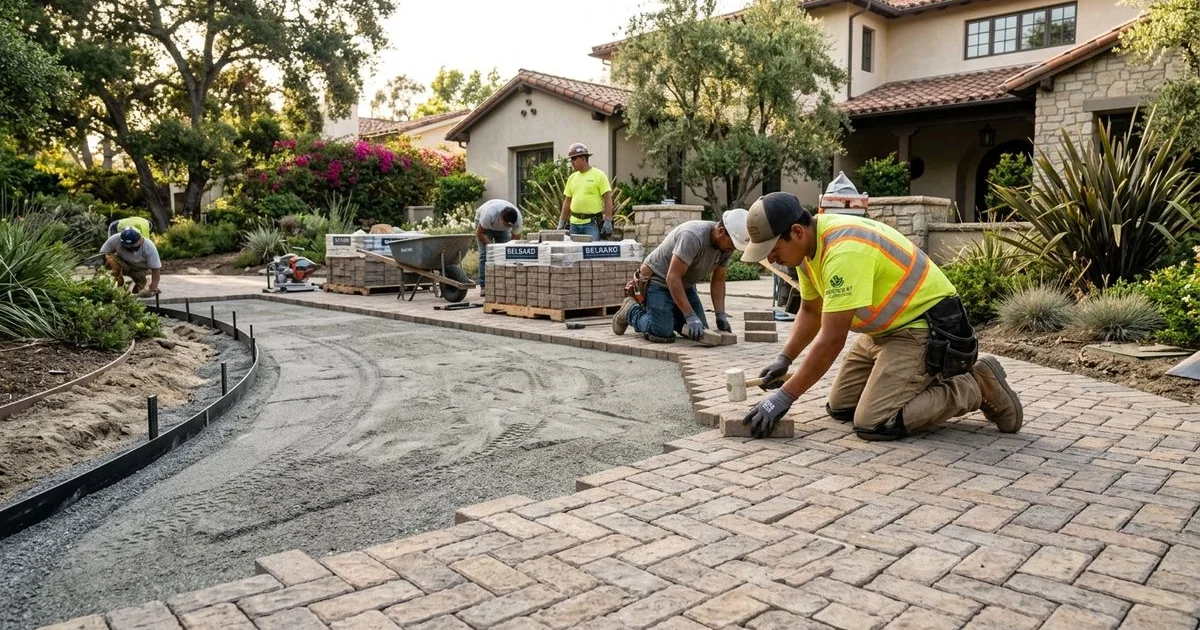
Labor is 50 to 65 percent of a paver driveway installation cost, so it pays to know what that labor buys. The method below is the standard professional sequence, and hiring a crew that follows it is the first step to a successful project. A complete professional installation covers six phases, and a reputable estimate itemizes each one:
- Layout and site preparation. Marking utilities, setting grade stakes and protecting adjacent landscaping and irrigation lines.
- Excavation. Removing soil and existing material to the proper depth, typically 11 to 13 inches for a driveway to allow for base, bedding and pavers under vehicle loads.
- Base construction. Layering crushed aggregate in thin lifts and compacting each lift with a plate compactor. This is the structural foundation of the driveway.
- Bedding and laying. Screeding a one-inch bedding sand layer, then placing pavers in the chosen pattern with clean cut edges.
- Edge restraints and joint sand. Restraints lock the field against lateral movement; polymeric sand swept into the joints hardens to resist weeds, insects and washout.
- Final compaction and cleanup. Seating the pavers with the plate compactor, checking joint sand coverage and removing all installation debris, leaving a driveway ready for vehicles after the joint sand cures.
When evaluating a driveway project, treat any estimate that skips or bundles these phases as incomplete. A low quote that trims base compaction routinely becomes a full reconstruction within two or three seasons, and reconstruction costs more than doing it right once.
Excavation, Demolition and Site Preparation Costs
Site work is the budget wildcard. On a clean, level lot it is a minor line item; on a difficult property it can rival the paving itself.
Excavation and grading typically run $1 to $5 per square foot, rising with depth requirements, rocky soil and haul distance. Driveways need a properly shaped subgrade sloped for drainage, usually a minimum two-percent grade (about a quarter inch per foot) away from the garage. Getting the grade right prevents the water problems that no surface material can fix.
Removing an existing driveway adds real money. Concrete demolition and disposal runs about $1.50 to $3.50 per square foot (roughly $550 to $1,700 for a standard two-car slab). Asphalt removal is cheaper, around $1 to $2 per square foot, and old gravel is cheapest because it can often be reused as fill.
Other preparation costs homeowners overlook: regrading a yard runs $1,000 to $3,300 where levels must change. Tree removal in the driveway path costs $200 to $2,000 per tree. Root pruning and protecting mature trees beside the excavation adds modest labor but saves the landscape. Utility locating before digging is essential and usually free through the 811 service in the United States.

Base, Bedding and Drainage: Where Driveways Succeed or Fail
Ask experienced professionals what makes a paver driveway last and you get the same answer: the base. A compacted gravel base, installed in lifts over geotextile, carries every vehicle load the surface will ever see. Vehicle loads demand far more structure than a patio, and the most common point of failure in driveways is a base built to patio depth. Heavy vehicles and wet soil punish thin bases, and shifting follows within a season or two.
A proper driveway base is 8 to 12 inches of compacted crushed aggregate (often Class II road base). Eight inches is the minimum for passenger vehicles on stable soil; clay or weak soils need more., placed in lifts of two to three inches and compacted at each lift, over a geotextile fabric that separates the base from native soil. Base material and placement typically add $1 to $3 per square foot. A one-inch layer of coarse bedding sand goes over the compacted base, and the pavers seat into it.
Drainage is the second structural issue. Water that ponds on or under a driveway erodes bedding sand, softens the subgrade and starts settlement. A sound drainage system, from surface slope to the gravel base below, protects the pavers, the driveway and the property around them. Solutions range from simple grading to channel drains at the garage, French drains along edges ($15 to $25 per linear foot) or a fully permeable paver system where the whole section infiltrates. Drainage corrections typically add $500 to $2,500 to a project, and skipping them risks the entire investment. Pooling water is the warning sign; if water stands on the old driveway today, the new one needs a drainage plan.

Standard vs. Premium Installation: What Upgrades Cost
The gap between a basic and a premium paver driveway comes from pattern, borders and finishes more than from the pavers themselves.
- Pattern complexity. Running bond and simple stacked patterns install fastest. Herringbone adds roughly 10 to 15 percent to labor because of angled cuts, and circular or custom inlay designs can double laying time.
- Borders and banding. A contrasting soldier-course border adds $3 to $8 per linear foot and visibly upgrades the entrance.
- Finish upgrades. Tumbled, sandblasted or color-through pavers add $2 to $4 per square foot in material.
- Sealing. Not required, but $1.50 to $3.25 per square foot applied every few years deepens color and resists staining from oil and leaf tannins.
A sensible middle path: a simple field pattern with a single contrasting border delivers most of the premium look at a fraction of the premium labor. Minor changes to pattern or border create major visual impact without major cost.
Replacing an Existing Driveway With Pavers
Replacing an old driveway with pavers combines both budgets above: demolition plus installation. The concrete slab or asphalt coming out has its own removal cost, and the new pavers, base and bedding have theirs. Expect the all-in cost to land at the top of the ranges, roughly $15 to $35 per square foot including removal, or $7,000 to $17,000 for a typical two-car driveway in concrete pavers.

Additional and Commonly Overlooked Costs
Budget beyond the paving itself for the expenses that surprise homeowners most. Consider each of these line items before comparing quotes:
- Permits. Many municipalities require a permit for a new or expanded driveway, typically $50 to $500, and some regulate how much of a front yard can become impervious surface.
- Drainage corrections. $500 to $2,500 when grading or drains are needed.
- Landscaping repair. Irrigation lines crossing the dig, lawn edges and planting beds beside the driveway need protection and sometimes repair; allow $200 to $1,000 depending on scope.
- Access limitations. Tight side yards or steep sites that force hand-carrying materials can add 20 to 30 percent to labor; a pallet of pavers weighs 2,000 to 3,000 pounds, and moving them by hand is slow, heavy work.
- HOA requirements. Design review, restricted work hours or mandated materials in some communities add time and occasionally cost.
- Aprons and approaches. The strip between street and property line sometimes falls under city rules and pricing; confirm who owns that scope.
An honest estimate names these items. If they appear nowhere in the quote, they will appear later as change orders.

Paver Driveway Cost vs. Concrete and Asphalt
Pavers are rarely the cheapest driveway on day one. The upfront price is higher, and the overall economics improve with time. The comparison that matters is cost over the surface’s life:
| Material | Installed cost per sq ft | Typical lifespan | Maintenance profile |
|---|---|---|---|
| Gravel | $2 - $6 | Indefinite with upkeep | Regrade every 2 - 3 years; annual top-ups |
| Asphalt | $7 - $12 | 15 - 30 years | Reseal every 3 - 5 years; softens in heat |
| Poured concrete | $8 - $18 | 30 - 50 years | Low upkeep; cracks require section replacement |
| Interlocking pavers | $10 - $30 | 25 - 50+ years | Occasional joint sand, sealing and spot repairs |
Two structural advantages justify the paver premium. First, repairability: a cracked or stained paver lifts out and a replacement drops in, typically a $200 to $400 spot repair, while cracked concrete means saw-cutting and replacing a whole section with a patch that never quite matches. Second, flexibility: the joints let the surface move with freeze-thaw cycles and minor soil movement instead of cracking, which is why pavers outlast rigid slabs in demanding climates.
Over 20 years and beyond, a paver driveway’s higher purchase price is often offset by cheaper repairs and longer service life, particularly for homeowners who plan to stay in the property. The investment case is strongest where the driveway is prominent, the climate stresses rigid concrete and asphalt, and the owner values a surface that can be renewed piece by piece.

Long-Term Ownership: Maintenance and Repair Costs
Paver driveway maintenance is modest but not zero. The trade for low maintenance overall is a short list of recurring tasks:
- Joint sand. Polymeric sand joints erode gradually; expect to top up joints every few years at $0.10 to $0.30 per square foot for materials.
- Sealing. Optional but popular for color and stain resistance: $1.50 to $3.25 per square foot every three to five years, including cleaning.
- Cleaning. An annual pressure washing keeps the surface fresh; budget around $90 for a day’s equipment rental or a modest service call.
- Weed control. Properly hardened polymeric sand resists most growth; occasional joint weeds pull easily.
- Spot repairs. Releveling a settled corner or replacing damaged units runs $200 to $400 per visit, a fraction of slab repair.
How to Evaluate a Professional Estimate
A paver driveway installation cost estimate is only useful if you can compare it. Three quotes is the classic advice, and it only works if the quotes describe the same job. When evaluating a driveway project, compare scope line by line:
- Excavation depth and base thickness stated in inches, with compaction specified.
- Base material named (for example, Class II road base) with geotextile fabric included.
- Demolition and haul-away itemized if an old driveway exists.
- Edge restraints, bedding sand and polymeric joint sand listed as line items.
- Drainage work described explicitly, not assumed.
- The exact paver named by manufacturer and product line, so material substitutions cannot hide in a vague allowance.
- Payment schedule tied to milestones, never a large sum up front.

How to Control Paver Driveway Costs Without Cutting Quality
Controlling paver driveway installation cost is about choices, not shortcuts.
There are honest ways to bring a paver driveway installation cost down, and there are shortcuts that cost more later. The honest ones:
- Choose concrete pavers in a simple pattern. Running bond with a single border looks sharp and installs fast.
- Right-size the project. Pave the parking and drive lanes generously, but connect with a walkway instead of widening the whole drive.
- Handle the easy prep yourself. Clearing plants, moving obstacles and arranging access saves crew time.
- Schedule off-peak. Late fall and early spring often bring better contractor availability and pricing.
- Get competitive, itemized quotes and compare scope, not just totals.
- Phase non-essentials. Sealing, decorative lighting and adjacent landscaping can follow later.
Reducing scope is fair; reducing quality is not. The steps above lower the total without touching the components that make the driveway last.
The shortcut to refuse is base work.

Do Paver Shapes, Sizes and Finishes Change the Price?
Within one material family, yes, but less than most homeowners expect. Large-format pavers cost slightly more per piece but cover ground faster, so installed cost often evens out. Specialty shapes, tumbled or sandblasted textures and color-through manufacturing add $2 to $4 per square foot in material. The real price drivers stay the ones already covered: pattern complexity, borders and site work.
A note on materials you may see marketed for driveways: porcelain pavers are excellent on patios and decks but are not typical for vehicle traffic, and stone veneer products are for vertical surfaces, not paving. For driveways, rated interlocking concrete pavers, clay brick and suitable natural stone remain the proven choices. Stick with products the manufacturer explicitly rates for vehicular use.
Is a Paver Driveway Worth the Cost?
For most homeowners who plan to stay in their home, the answer is yes, for three reasons. The value case rests on how pavers, concrete and asphalt differ over decades. A concrete slab or asphalt surface is a single wear surface. Interlocking pavers are thousands of small replaceable units set over a renewable gravel base and sand bed.
First, curb appeal is real money. The driveway is the largest hard surface on most front properties, and a quality paver driveway visibly lifts the whole property. Second, the longevity math favors pavers: a 30-plus-year paver surface with cheap spot repairs beats a 20-year concrete slab with expensive crack repairs, and the driveway keeps its looks the whole time. Third, the renovation is renewable. Utility work, tree-root damage or a settled corner becomes a lift-and-relay repair, not a demolition.
The honest counterpoint: if the budget is tight and the house will sell soon, poured concrete delivers most of the function for less money. Pavers are the choice for homeowners who value appearance and long-term ownership economics over the lowest initial cost. For further reading, explore the related articles in this series, or contact a local installer for a site visit. The FAQs below cover the questions homeowners ask most.
How to Prepare for Paver Driveway Installation Day
A little homeowner preparation keeps the job efficient and protects the quoted price. Before the crew arrives:
- Clear the work area. Move vehicles, planters and furniture off the driveway and the staging area beside it.
- Plan your parking. You will not have driveway access for three to five days, so arrange street parking and check local regulations first.
- Mark what matters. Point out irrigation lines, lighting wires and anything buried the crew should know about, and confirm utilities have been marked.
- Protect the surroundings. Ask how the crew will protect adjacent landscaping, and photograph the yard’s current condition.
- Confirm the details in writing. The paver product, pattern, border, base depth and payment schedule should all be in the contract before the first machine arrives.
Good preparation is the cheapest insurance available. Jobs that start with a clear site and a clear contract finish faster and with fewer change orders.
Ridgeline Outdoor Living: Our Approach to Driveway Installation
If you are pricing a project now, Ridgeline Outdoor Living designs and builds paver driveways, patios and outdoor living spaces in Pasadena, California and surrounding communities. In our approach to driveway installation, the estimate conversation starts at the site: soil, slope, drainage and access get evaluated before any number is quoted, because those conditions decide what the driveway actually needs.
We recommend treating the base specification and the drainage plan as the heart of any quote you compare, ours included. If you are weighing materials or want a site-specific number rather than a national average, our team is glad to walk the property and price your project properly. Learn more about our professional paver driveway installation services.

Paver Driveway Repair Costs: What Goes Wrong and What It Costs
Long-term cost is where driveway pavers separate themselves from slabs, so it helps to know the actual repair menu. Most paver driveway issues trace back to installation quality, and each has a known, modest fix:
- Settled or rutted areas from poor base compaction: lift, re-base and re-lay, typically $200 to $400 for a corner, more for a wheel track.
- Spreading edges from missing or failed edge restraints: re-set the border with proper restraints, usually a few hundred dollars.
- Joint sand loss leading to weeds or ant activity: clean and re-sand with polymeric sand, $0.10 to $0.30 per square foot in materials.
- Stains from oil or rust: specialty cleaners handle most; badly stained units simply get replaced.
- Cracked or chipped pavers from impact damage: individual replacement at $5 to $15 per unit plus labor.
Compare that menu with concrete driveways, where cracking means patching that never matches or replacing whole sections, and with asphalt, where patching and resealing are recurring calendar items. The repairability of pavers is a financial feature, not just a convenience.

Frequently Asked Questions

How much does a paver driveway cost per square foot?
Installed, the average cost of a paver driveway runs $10 to $30 per square foot in 2026, all-in with labor, base and materials. Basic concrete pavers sit at the bottom of that range; natural stone, cobblestone and permeable systems sit at the top.
What is the average total cost of a paver driveway?
For a standard two-car driveway of about 480 square feet, most owners spend $6,000 to $18,000, with a national average near $12,000. Large, long or premium-material driveways can exceed $25,000. That typical range works out to roughly $12.50 to $37.50 per square foot for this size, which sits slightly inside and above the headline $10 to $30 planning range. The difference is fixed costs and material mix: real two-car projects rarely use the cheapest possible specification, so reported totals run above the simple rate-times-area floor.
Is a paver driveway more expensive than concrete or asphalt?
Up front, yes. Asphalt installs for roughly $7 to $12 per square foot and poured concrete for $8 to $18, against $10 to $30 for pavers. Over 25 years the gap narrows or reverses, because pavers repair by the unit and outlast both.
How much does it cost to replace a concrete driveway with pavers?
Budget demolition at $1.50 to $3.50 per square foot plus the new installation: typically $15 to $35 per square foot combined, or $7,000 to $17,000 for a two-car driveway in concrete pavers.
What is the cheapest way to install a paver driveway?
Concrete pavers in a running bond pattern on a well-drained, level site, scheduled off-peak, with itemized competing quotes. Do not cut the base; it is the false economy that rebuilds driveways.
How long does a paver driveway last?
Twenty-five to fifty years or more with ordinary maintenance. The surface is effectively renewable, because individual pavers can be lifted and replaced indefinitely.
Does a paver driveway need sealing?
No, sealing is optional. It deepens color and resists stains at $1.50 to $3.25 per square foot every three to five years. Unsealed pavers age naturally and remain fully functional.
Are permeable pavers worth the extra cost?
Where stormwater rules apply or drainage is a problem, often yes: the $6 to $10 per square foot premium can cost less than separate drainage infrastructure. On a well-drained site with no requirements, standard interlocking pavers are usually the better value.
Can I install a paver driveway myself to save money?
DIY materials and equipment rental run roughly $12 to $17 per square foot, so savings are smaller than they appear once tools, base materials and waste are counted. Driveways carry vehicle loads that punish installation mistakes, and correcting a failed base costs more than professional installation. We recommend professional installation for driveways, and reserve DIY for small patios and walkways.
What adds the most to paver driveway installation costs?
In order: premium materials, site problems (slope, drainage, access), demolition of an existing driveway, and complex patterns. A plain concrete-paver driveway on a clean site is a different financial animal than a stone driveway on a slope.
How do I estimate my own paver driveway cost?
Measure length times width for area, multiply by $15 to $25 for a realistic mid-range installed rate, then add demolition if you are replacing a driveway and $500 to $2,500 if drainage needs work. That range will bracket most professional quotes. Any online cost calculator uses the same inputs, so run your own numbers before the first site visit.
Does a paver driveway increase home value?
A well-built paver driveway improves curb appeal and typically supports resale value, and owners consistently rate driveway paving among the outdoor upgrades they enjoy most. Appraisers and buyers read a clean paver driveway as a maintained property., particularly where neighboring homes already have upgraded hardscaping. Treat it as an investment in daily use and durability first, with resale benefit as a bonus.
How often do paver driveways need repairs?
With a proper base, rarely. Expect joint sand top-ups every few years, optional sealing on a three-to-five-year cycle, and the occasional $200 to $400 spot repair. Chronic settling or spreading almost always traces back to base or edge-restraint shortcuts at installation.
What should a paver driveway quote include?
Itemized excavation and demolition, base depth and material, the named paver product, edge restraints, joint sand, drainage work, cleanup and a workmanship warranty. Use that as your comparison checklist when collecting quotes.
Why do paver driveway quotes vary so much between contractors?
Overhead, crew efficiency, material purchasing and honesty about scope. A quote that excludes base or drainage work looks lower until the change orders arrive. Compare line items, and be ready to walk away from any quote you do not understand.
Do paver driveways work in cold climates?
Yes. The joints let the surface flex through freeze-thaw cycles that crack rigid slabs, which is one reason pavers dominate premium driveways in northern states. Base depth increases in frost regions, which adds cost, and snow removal is safe on a well-built surface.
How much should I budget beyond the quoted price?
A contingency of 10 percent covers most surprises: extra demolition, soil that needs more base, or drainage corrections discovered during excavation. If the site visit was thorough, the quote should already include them.

The Bottom Line on Paver Driveway Installation Cost
Your paver driveway installation cost comes down to five decisions: the material you choose, the size and shape of the driveway, the condition of the site, what has to be demolished, and the crew you hire. National planning numbers are straightforward: $10 to $30 per square foot installed as a rate range, $6,000 to $18,000 as the typical completed-project total for a two-car driveway, and a cost structure that rewards homeowners who compare itemized quotes and refuse to cheapen the base.
Build the base right, choose a material that fits your budget and your house, hire professionals who itemize their work, and a paver driveway will outlast most of what you park on it.
A free on-site consultation, a phased budget tier, and a master plan that fits your property and your goals.