

Paver Driveway Load Requirements
Learn paver driveway load requirements for cars, SUVs, pickups and RVs, including paver thickness, base construction, soil, compaction and load distribution.
On this page
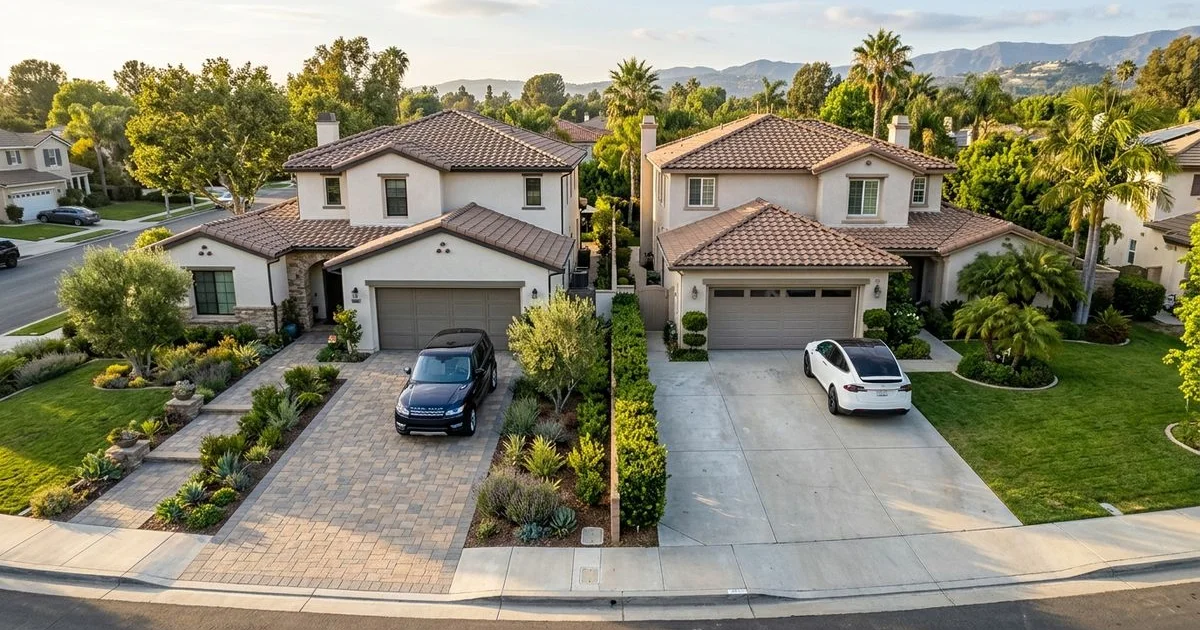
A well-built paver driveway can support cars, SUVs and pickup trucks. Still, no single weight limit fits every driveway. Paver driveway load requirements depend on the whole pavement system. The strength and thickness of each block are only part of the answer.
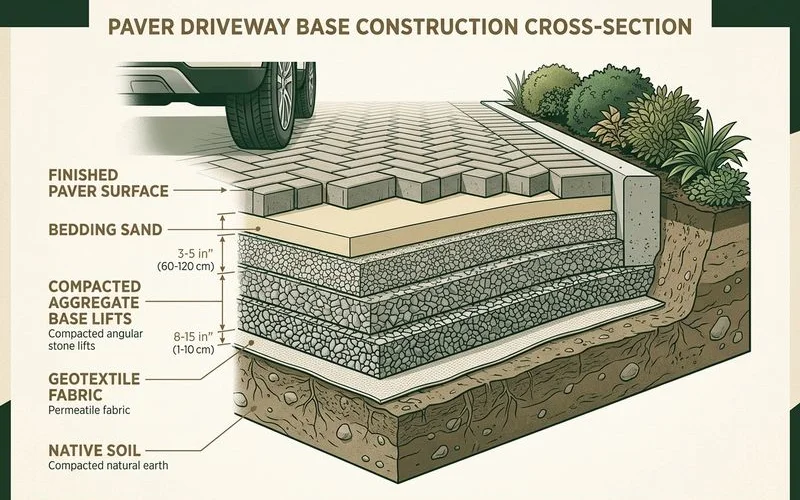
The pavers form the surface you see. Below them are bedding material, joint sand, edge restraints, an aggregate base and the soil subgrade. Each layer helps spread the vehicle load. Strong pavers can still sink into weak soil. Poor drainage or poor compaction can cause the same kind of failure.
Online charts may show paver driveway load limits or one paver driveway load capacity figure. Do not use them as a project design. This guide explains what to check at your home before you park a loaded pickup, RV, boat trailer or heavy delivery truck on pavers. It also shows why a compressive-strength figure is not a driveway load rating.
Quick Answer: Paver Driveway Load Requirements for Vehicles
A residential system built for normal car traffic will commonly serve passenger cars and family SUVs. Many can also carry pickup trucks. The answer changes when a vehicle is fully loaded or very heavy. Repeated turns in the same spot also add stress.
Use this table as a screening guide, not as a weight certification.
| Vehicle or use | Practical load review |
|---|---|
| Passenger car | Usually compatible with a properly designed residential paver driveway using driveway-rated materials. |
| SUV or crossover | Generally similar to a passenger car, but consider its loaded weight, axle loads and repeated turning movements. |
| Pickup truck | Review passengers, tools, cargo and payload. An empty pickup and a loaded work truck do not create the same demand. |
| RV or motorhome | Requires specific review. Axle loads, long-term parking, leveling equipment and weak soil can control the design. |
| Boat or utility trailer | Check the trailer’s loaded axle weight and the tongue load. A detached trailer jack creates a concentrated point load. |
| Moving, delivery or dump truck | Do not assume access is safe. A loaded truck can require a thicker or stabilized base and heavier vehicular details. |
| Dumpster or equipment outriggers | Treat these as concentrated loads. Their feet, wheels and supports may need a separate engineered surface or protection plan. |
| Fire truck or heavy construction equipment | Obtain a project-specific structural review before allowing access. Ordinary residential details should not be presumed adequate. |
Frequency matters too. One controlled delivery differs from daily commercial use. Repeated heavy loads can cause ruts and loss of support. This can happen even when the surface survives the first pass.
Understanding Driveway Load Capacity Requirements
Product guides and contractors often use these terms in different ways. Here is what they mean for your project:
- Driveway load capacity is the full pavement’s ability to carry traffic without too much rutting or movement.
- A driveway load requirement describes the demand the design must handle. Vehicle load requirements include weight, axles, support points and repeat passes.
- Paver driveway load capacity refers to that full assembly when interlocking pavers form the surface. It is not the compressive strength of one block.
- A paver driveway load requirement should lead to a defined pavement section. It should not lead to a generic maximum-weight claim.
- Driveway loading requirements describe how the load is applied. Parking, turning, braking and long-term storage create different demands.
- Paver load requirements cover the unit’s thickness, shape, aspect ratio, material and ability to interlock.
- Heavy load requirements are the added steps needed for RVs, loaded trucks or equipment. These may include a deeper or stabilized base and stronger edge details.
A driveway load capacity requirement must also consider time. The pavement may need to carry thousands of light passes and a few heavy ones. Its design life and allowed movement are part of the review. Each vehicle load requirement should match real use.
A paver driveway load limit is therefore project-specific. It is the use limit supported by the chosen design. It is not a universal number printed on a bundle of pavers.
Why There Is No Single Driveway Load Limit
A paver driveway is not like a bridge with one posted limit. Interlocking concrete pavement acts as a flexible system. It spreads wheel loads through the layers and into the soil.
The resulting load capacity for driveways depends on several connected parts:
- Paver thickness, shape, aspect ratio and material.
- Joint sand and the degree of vertical, rotational and horizontal interlock.
- Laying pattern and resistance to braking or turning forces.
- Edge restraint strength and continuity.
- Bedding thickness and material.
- Aggregate base quality, depth, moisture and compaction.
- Subgrade strength, drainage and changes during wet weather.
- Vehicle weight, axle configuration, tire contact area and number of passes.
This is why two driveways with the same paving stones can perform differently. One may stay stable for years. The other may settle after one wet season or a few heavy deliveries.
Compressive strength is not pavement capacity
CMHA guidance lists these ASTM C936 values for concrete pavers. The minimum average compressive strength is 8,000 psi. No individual test unit may be below 7,200 psi. PSI means pounds per square inch. The test measures paver samples.
That value does not mean a vehicle can place 8,000 pounds on every square inch of the driveway. It does not rate the bedding, base, soil or joints. It also ignores repeat traffic and side forces.
Natural stone, porcelain and other products need their own review. Granite, quartzite, basalt, travertine, brick and cobblestones vary in strength and shape. Their install methods also differ. A concrete paver made for a patio may differ from one made for a truck route.
Patios and walkways often use thinner units than driveways. A patio slab or decorative product may not suit vehicular traffic. The same caution applies to large porcelain slabs. Ask for product data and test results that cover driveway use.
A warranty or high price does not prove suitability. In a hardscape plan, strength must come before looks. Hardscaping choices such as colors, textures and curb appeal still matter. These aesthetic features do not set load capacity.
An 18,000-pound ESAL is not a weight limit either
Pavement engineers use equivalent single axle loads, or ESALs, to compare mixed traffic. The standard reference axle is 18,000 pounds, or about 80 kN. This is a design unit. It is not a recommended residential driveway load limit.
Under the AASHTO approach described by CMHA, damage rises roughly with the fourth power of axle load. Double the axle load, and this model gives about 16 times the damage. Real design is more complex. Still, the point is clear. A few heavy trucks can matter more than a much larger count of cars.
How Vehicle Loads Reach the Driveway
Total vehicle weight is only the starting point. The pavement receives load through tires, axles and support gear. Those contact points can change as the vehicle moves.
Start with the actual loaded vehicle
Check the vehicle certification label and owner’s manual. Two useful terms are:
- Gross vehicle weight rating (GVWR): The manufacturer’s maximum loaded weight for the vehicle, including its passengers and cargo.
- Gross axle weight rating (GAWR): The manufacturer’s load-carrying rating for an individual axle system, measured at the tire-ground interface.
GVWR is not the actual scale weight. A pickup may carry little cargo today and be near its rating tomorrow. For an RV, trailer or work truck, use actual loaded scale weights when you can. They give better data than an empty showroom specification.
Towing adds more variables. Trailer axles carry part of the load. Tongue weight shifts load to the tow vehicle. Once the trailer is detached, its jack or stabilizers may place a large force on a very small area. This adds a new loading requirement at each support point.
Static, moving and point loads are different
A parked vehicle creates a static load. Braking, accelerating and turning add horizontal forces. Turning the steering wheel while stationary can be especially demanding on the joints and laying pattern.
Axle weight is not always split evenly between tires. Suspension, slope, cargo position and movement change the load distribution. A tire’s contact patch is also much smaller than the driveway surface. Do not divide total vehicle weight by the full driveway area. That does not give a safe pressure rating.
Point loads need separate attention. Trailer jacks, RV leveling pads, dumpster feet, ladder feet and equipment outriggers focus force on small areas. Timber or proprietary mats may help spread some loads. They do not guarantee protection. Their size and stiffness must suit the support below.
Paver Thickness and Product Selection
Thickness matters, but it works with aspect ratio and interlock. Aspect ratio is the paver’s length divided by its thickness. A long, thin unit can rotate or flex more easily than a compact, driveway-rated unit.
Selecting a thicker product is a design choice, not a full solution. The best unit is not always the thickest. Thickness alone does not make it superior. Product durability and the layers below still affect performance. The paver requirements for a driveway may differ from those for a patio.
CMHA guidance commonly recommends:
- 2 3/8 inches, or 60 mm: Pedestrian areas and residential driveways with limited automobile use, subject to the applicable aspect-ratio limit.
- 3 1/8 inches, or 80 mm (often written 80mm): General vehicular applications and designs that need greater rotational interlock.
- 4 or 5 inches, or 100 to 120 mm: Some heavy-duty commercial pavements and other demanding uses, as selected by the designer.
These are product-selection guidelines. They do not promise that a thicker block will carry an RV on any base. The design must also address traffic, soil and drainage.
A nominal 2-inch paver is thinner than the 60 mm guideline. That guideline applies to a conventional residential interlocking concrete driveway. Do not substitute a thinner unit without written manufacturer approval. A structural design review may also be needed. Large porcelain or natural-stone patio slabs need the same caution.
Rectangular concrete pavers can form an effective herringbone pattern. Other shapes may be suitable. The designer or manufacturer should confirm equal structural performance. A modern, classic or contemporary style says nothing about load capacity.
Cut pieces also matter. CMHA vehicular guidance says a cut paver exposed to tire traffic should be no smaller than one-third of a full unit. Avoid narrow slivers at borders. Plan the layout around fixed edges.
Aggregate Base Requirements
The aggregate base is the primary structural layer in a conventional flexible paver driveway. It spreads wheel loads and gives the pavers a stable platform. It also helps protect the subgrade. In paver base construction, clean crushed stone with a suitable gradation is normally specified for vehicular use. Its angularity and fines content affect stability and drainage.
Rounded pea gravel, loose river rock and ordinary dirt are not equal substitutes. The material should be free of organic debris and approved for the project.
Base depth depends on the site
General CMHA application guidance lists a minimum aggregate base range of 6 to 8 inches for driveways. Its construction guide also calls for at least 6 inches over well-drained soils for residential driveways. These are baseline guidelines. They are not universal paver driveway requirements.
A greater depth or a stabilized base may be needed for:
- Weak, expansive or continually wet subgrade soils.
- Uncontrolled fill or old utility trenches.
- Heavy vehicles or frequent truck repetitions.
- Poor soil drainage or standing water.
- Steep terrain and demanding turning areas.
- Commercial applications or construction equipment.
An engineer may use soil tests such as California Bearing Ratio, R-value or resilient modulus. These tests help measure soil support. Traffic can be described by axle loads and expected repetitions. This gives a more reliable design than copying a neighbor’s excavation depth.
The apron and tight turns may need a different section from the center of the driveway. Options include a heavier base or geosynthetic reinforcement. Cement- or asphalt-stabilized material may help. A solid concrete apron may also be appropriate. These choices are site-specific.
Bedding is not the structural base
Conventional interlocking concrete pavement commonly uses about 1 inch, or 25 mm, of bedding sand. This relatively thin layer provides a uniform setting bed. It is not a substitute for aggregate base depth.
Too much sand can reduce stability. Use the specified washed, graded material. Do not swap in arbitrary stone dust or fill. Permeable pavers use different systems. Permeable interlocking concrete pavement normally has open-graded aggregate bedding and joint material. Do not mix the conventional and permeable recipes.
Pavers over an existing concrete slab or asphalt also need a different review. The designer must check the old structure, joints, cracks and drainage. Bedding retention also matters. A rigid concrete base does not make every surface detail suitable.
Soil Conditions, Drainage and Compaction
The subgrade is the natural or prepared soil below the aggregate. Its condition can change with moisture. Soil may feel firm during a dry inspection. It can still lose support after winter rain or long periods of irrigation.
Identify weak ground before installation
A site assessment should look for clay, loose fill, organic dirt, buried debris and old excavation work. Soft spots should be removed or stabilized as the design requires. Adding more bedding sand will not bridge them.
Expansive soil can swell and shrink as moisture changes. Saturated soil can pump under construction equipment and traffic. Contaminated or highly organic soil may need removal rather than compaction. A qualified engineer should review uncertain conditions.
Water management is part of the load design. Roof runoff, a sloped yard, a blocked swale or a leaking irrigation line can saturate the base. The landscape, lawn and gardens can also supply water. High groundwater may need another drainage solution.
Direct water away from the pavement and each building, wall and foundation. This includes retaining walls beside the driveway. Local code and site conditions may control the discharge point. Do not let standing water remain beside the edge.
Geotextile separation or geogrid reinforcement may help in some soil conditions. Neither is a universal cure. Their selection and placement should follow the structural and drainage design.
Compaction must be measurable
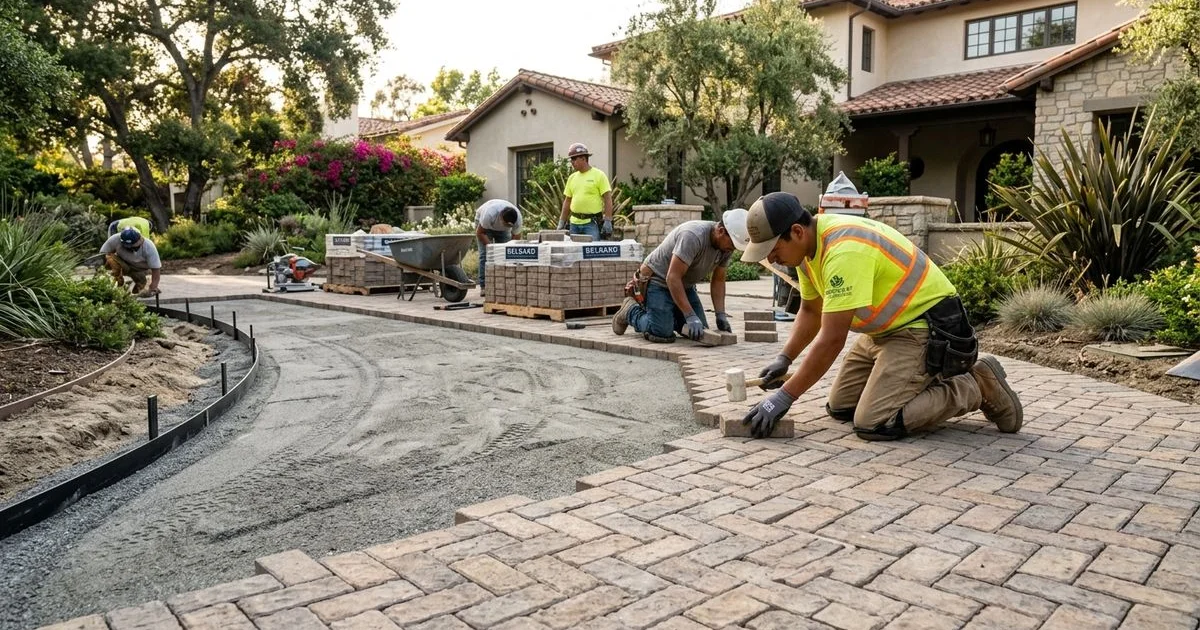
Each layer needs proper preparation. The subgrade is graded and compacted or stabilized as specified. Aggregate is then placed in suitable lifts. The crew adds or removes moisture as needed and compacts each lift. Loose aggregate spread to the final depth in one pass may stay weak below the surface.
CMHA construction guidance calls for residential driveway bases to reach at least 98% of standard Proctor density. For vehicular areas, it describes at least 98% of modified Proctor density. These are different test contexts. The project specification and local requirements should name the applicable test. They should also state the moisture condition and inspection method.
These percentages are laboratory-based density targets. They do not mean the driveway can carry a set number of pounds. They give the contractor and inspector a measurable quality requirement. A quote that says only “base compacted” leaves an important detail undefined.
Compaction against curbs, utility structures and edge restraints needs special care. Large compaction equipment may not reach these areas. Contractors may need smaller tools and thinner lifts. These steps help ensure consistent support. Small, loose or poorly compacted zones often settle first.
How Interlock Distributes Vehicle Loads
Interlock means that one paver cannot move on its own. Interlocking concrete pavers develop this connection in three ways:
- Vertical interlock: Filled joints transfer shear forces to surrounding units.
- Rotational interlock: Adequate thickness, suitable aspect ratios and close placement resist rotation.
- Horizontal interlock: Laying patterns and fixed edges resist braking, turning and acceleration forces.
Joint sand is more than a cosmetic filler. During final compaction, each installed paver seats into the bedding. Sand then fills the joints. This links the separate units into a surface that can spread loads. The surface is ready for its intended traffic only after these steps are complete.
A herringbone layout is often recommended for vehicular applications. It resists side-to-side movement well. Stable edge restraints are just as important. A concrete curb or another approved fixed edge prevents the perimeter from spreading under repeat tire loads.
Missing joint sand, rocking units and open perimeter gaps reduce structural integrity. So does a shifting curb. Maintaining interlock starts with fixing these conditions. Inspect them before heavier vehicles use the driveway. Maintenance cannot restore a failed subgrade. It can help preserve interlock in a sound system.
Load Requirements for RVs, Trucks and Other Heavy Uses
Plan for paver driveway loading requirements before the vehicle arrives. Tell the contractor which vehicles will use the property. State how often they will pass and where they will stop or turn.
Document each heavy load requirement in the project scope. A paver driveway load capacity requirement may call for a custom section. Each paver driveway loading requirement should be clear before work starts. This is not a DIY estimate or a detail to leave until after installation.
RVs and motorhomes
RV weights vary widely. Use loaded axle weights. Do not rely on a model name or an unloaded brochure figure. Include water, passengers, cargo and any towed vehicle in the travel plan. Long-term parking creates a different exposure from an occasional visit.
Leveling jacks and stabilizers need a separate review. Do not place them on small pads without checking the support below. A designer may call for heavier vehicular pavers or a deeper base. A stabilized base or dedicated reinforced parking area may also help. A backyard RV space can have different requirements from the main drive.
Pickups, trailers and work vehicles
A pickup used for commuting differs from one carrying masonry, tools or landscaping materials each day. Payload and towing habits affect the load requirement. Repeated stops at the same gate or garage entrance also need attention.
For a boat or utility trailer, check both its loaded axle load and its support during storage. A driveway that handles the tow vehicle may still be vulnerable under a detached trailer jack.
Delivery trucks, dumpsters and construction equipment
Where practical, keep heavy delivery and concrete trucks on the street. Use other material-handling methods. If access is necessary, have the contractor review the loaded axle weights and route in advance.
Do not place dumpsters on pavers by default. The filled weight, pickup operation, feet and dragging forces can all cause damage. A separate concrete slab or an engineered protection plan may be needed. Rebar inside a nearby slab does not certify the adjacent paver driveway for the same load.
Emergency access is another design case. A fire truck or heavy service vehicle may need to enter. Define that requirement before construction. It is much harder to add structural capacity after the paving is complete.

A Homeowner’s Load-Planning Checklist
Before requesting a design or quote, prepare the following information:
- List the vehicles. Include cars, SUVs, pickups, RVs, trailers and likely visitors.
- Record loaded weights. Use certification labels, manuals and actual scale measurements when available.
- Describe use and frequency. Separate daily parking from an occasional moving truck or emergency delivery.
- Mark load locations. Identify aprons, tight turns, long-term parking spaces, trailer jacks and dumpster positions.
- Document the ground. Note fill, clay, previous settlement, poor runoff and standing water after rain.
- Request a complete section. The proposal should identify paver thickness, aspect ratio, pattern, bedding, base material and depth, compaction, drainage and edge restraint.
- Clarify heavy-load details. Ask whether stabilization, engineering or a reinforced parking bay is included rather than assuming it is standard.
Share the same information with each contractor. This makes estimates easier to compare on structural performance. Cost, color and style alone do not show whether the designs are equal. It also gives the design team a clearer basis for material selection and inspection.
If you want to consider a future RV, mention it now. A good plan can address it before work is done. Clear answers to questions about axle loads and support points give you more confidence in the final choice.
The same whole-section principle applies to reinforced turf. Its materials and maintenance are different. Our guide to grass grid paver driveway installation explains grid-specific base preparation, drainage and grass establishment.
Warning Signs That Deserve an Inspection
Do not ignore rutting, rocking pavers, widening joints or a spreading perimeter. Other warning signs include cracking in edge restraints, recurring sand loss and water trapped near the surface.
These symptoms do not tell you the exact load capacity. They show that interlock, drainage or support may already be compromised. Stop heavy vehicle use in the affected area until a contractor inspects it. Adding sand to the surface alone will not fix a weak base or failed subgrade.
Frequently Asked Questions
How much weight can a paver driveway hold?
There is no reliable single figure. A properly designed residential driveway can serve ordinary passenger vehicles. Its actual capacity depends on the pavers, joints, bedding, base and soil. Drainage, compaction and traffic also matter. Loaded RVs and trucks need project-specific review.
Can pavers support an SUV or pickup truck?
Yes, when the complete installation has been designed for that use. Check the loaded vehicle and payload. Not every pickup creates the same load. Repeated turns and heavy cargo can increase the design demand.
Are 2-inch pavers thick enough for a driveway?
Do not assume so. Two inches is less than the 60 mm, or 2 3/8-inch, CMHA guideline. That guideline is commonly used for residential interlocking concrete driveways. Product approval, aspect ratio and the entire structural section need review.
Will a dump truck or concrete truck crack my pavers?
Cracked units are possible. Rutting and settlement can also indicate pavement damage. The answer depends on loaded axles, route, soil and construction. Keep the truck off the driveway until its access has been assessed.
Can I put an RV or boat trailer on pavers?
Possibly, but use loaded axle weights and review every support point. Trailer jacks, stabilizers and RV leveling equipment focus force on small areas. They can create higher local demands than the tires. A dedicated reinforced area may be appropriate.
Does a thicker paver always mean a stronger driveway?
No. Thickness can improve rotational interlock. It cannot compensate for unsuitable aspect ratios, poor joint filling or weak edges. It also cannot fix soft soil or an inadequate base. Heavy-use designs often need changes to several layers.
Can I install driveway pavers directly over dirt?
No. Organic material and loose dirt do not provide a dependable structural section. Excavate and prepare the subgrade, then install the specified compacted aggregate base, bedding and edge restraint.
Conclusion
Paver driveway load requirements are not set by one paver specification or a generic internet weight chart. Safe capacity comes from matching the actual vehicles and support points to the full driveway. That section must be well drained and built for the site.
Passenger cars and many SUVs fit conventional residential design assumptions. Loaded pickups, RVs, trailers and heavy equipment need closer analysis. Paver thickness, base construction and soil conditions must work together. Compaction and interlock matter too.
Ridgeline Outdoor Living can review your vehicles, ground conditions and planned use. Ask us for a site-specific assessment and professional paver driveway installation. We can then recommend a driveway section for your property.
Sources and References
- ASTM C936, Standard Specification for Solid Concrete Interlocking Paving Units supports the minimum compressive strength values cited for concrete pavers.
- Concrete Masonry & Hardscapes Association, PAV-TEC-009 Guide Specification for Interlocking Concrete Pavement supports vehicle-rated paver thickness guidance, bedding sand depth, aggregate base construction, edge restraint, compaction targets and ESAL-related pavement design context.
- Concrete Masonry & Hardscapes Association, Cleaning, Sealing and Joint Sand Stabilization of Interlocking Concrete Pavement, PAV-TEC-005 supports vertical, rotational and horizontal interlock and joint-sand performance in vehicular applications.
- NHTSA: Understanding Vehicle Weight Classifications and Labeling supports the definitions of gross vehicle weight rating (GVWR) and gross axle weight rating (GAWR) used in the load-planning discussion.
A free on-site consultation, a phased budget tier, and a master plan that fits your property and your goals.