

Retaining Wall Drainage: How Proper Drainage Prevents Wall Failure
Learn how retaining wall drainage works, why it matters, and how drain pipe, gravel backfill, grading and water management help prevent wall failure.
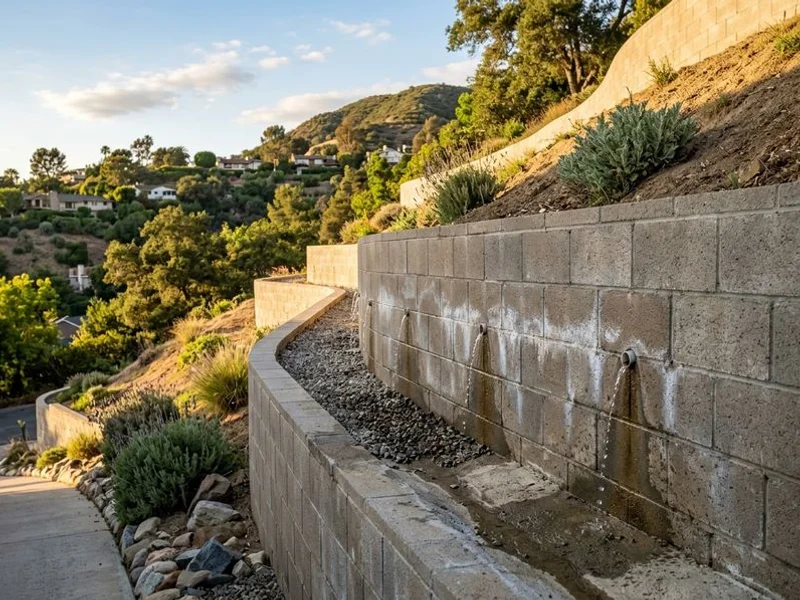
A retaining wall does two jobs at once. The obvious one is holding back soil. The less visible one is managing water, and in our experience building and repairing walls around Pasadena and the greater Los Angeles foothills, water is where most wall problems begin.
When water collects behind a wall, the retained soil becomes saturated and heavier, hydrostatic pressure builds against the structure, and fine soil particles migrate. Left alone, that combination can erode the base, undermine the footing, and push a wall toward cracking, bowing, leaning or outright failure.
Proper retaining wall drainage exists to interrupt that process: give water a controlled path through the backfill, collect it in a drain pipe, move it to a safe outlet, and use grading to keep surface water away from the wall.
Why Retaining Walls Need Drainage
Retained soil collects water readily and releases it slowly. The sources are familiar: rainfall, landscape irrigation, surface runoff from uphill properties, roof downspouts and everyday watering.
When the retained area cannot drain, a predictable sequence follows. The soil saturates and gains weight. Hydrostatic pressure builds as undrained water pushes with full fluid pressure. Fine particles migrate toward any opening, erosion begins at the base or ends, and the loads on the wall climb.
This is why drainage is not an optional accessory but part of the wall system itself, planned as deliberately as the footing or reinforcement.
What Does a Proper Retaining Wall Drainage System Include?
There is no single universal drainage design; soil, wall height, grade and loads all shape the solution. Most well-drained walls combine several of the components below.
Free-Draining Backfill
Behind the wall face, a zone of clean crushed stone or gravel replaces native soil. Free-draining material lets water move downward to the collection point at the base instead of lingering against the wall, while clay-heavy native soil holds it in place.
Drain Pipe
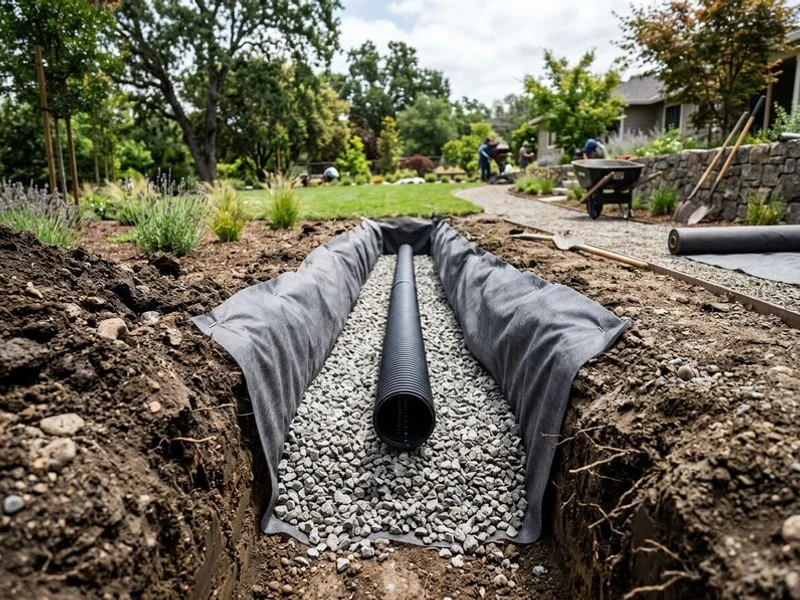
Near the base of the retained side, a perforated drain pipe collects the water the backfill delivers and carries it to a safe outlet. Two details matter most: the pipe must slope continuously toward discharge so water flow never stalls, and the outlet must release water somewhere appropriate, such as daylight at a lower grade. A wall drain without a functioning outlet is just a reservoir against the footing.
Filter Fabric and Soil Separation
Drainage stone works only while it stays clean. Where crushed stone meets native soil, filter fabric keeps fine particles from migrating into the gravel and clogging it. This hidden layer is often the difference between a system that works for decades and one that silts up in a few years.
Weep Holes
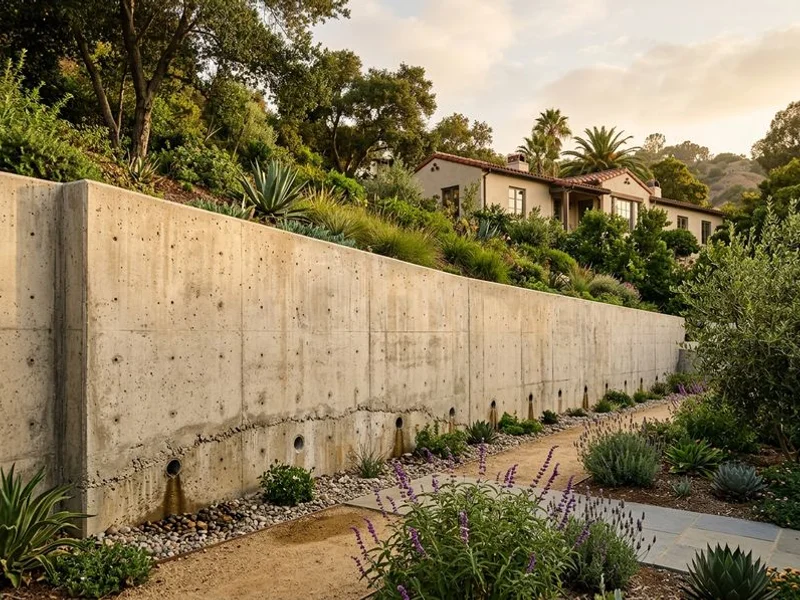
Weep holes are openings through the wall face, usually near the base, that let water escape directly rather than building pressure behind it. They are common on poured concrete and masonry block walls; many segmental systems drain through open joints instead. Blocked or poorly located weep holes defeat their purpose, and weep holes alone are never a complete drainage system. Keeping outlets clear is part of ongoing retaining wall maintenance on an existing wall.
Surface Grading
Subsurface drainage handles water that reaches the backfill. Surface grading tries to keep it from arriving at all. The finished landscape should slope water away where practical, prevent runoff from concentrating behind the wall, carry downspout discharge clear of the retained area, and avoid irrigation overspray. Surface and subsurface drainage are complements: a good drain pipe cannot compensate for grading that dumps every storm against the wall.
French Drains
A French drain, a gravel trench with perforated pipe that intercepts groundwater, can be a useful part of a broader drainage solution, especially upslope of a wall where it cuts water off before it arrives. But it is not a universal answer. A poorly located French drain can collect water and deliver it toward the wall, which is worse than doing nothing. One belongs only where the water source, the grades and a safe discharge point all support it.
| Drainage component | Purpose | Common problem |
|---|---|---|
| Free-draining backfill | Moves water down to the collection point | Native soil used instead, trapping water |
| Drain pipe | Collects water and carries it to an outlet | No slope, no outlet, or crushed during backfill |
| Filter fabric | Keeps fines from clogging the drainage layer | Omitted, so the gravel silts up |
| Weep holes | Relieve water through the wall face | Blocked by soil, mulch or debris |
| Surface grading | Keeps runoff away from the retained area | Grade directs water toward the wall |
| French drain | Intercepts groundwater upslope of the wall | Located where it feeds water to the wall |
Signs Your Retaining Wall Has a Drainage Problem
Drainage trouble usually announces itself before major structural movement, which makes early signs worth taking seriously:
- Water staining or dark streaks on the wall face
- Efflorescence, the white mineral deposits left by water moving through masonry
- Soil washing through joints or gaps
- Standing water behind or near the wall after rain
- Areas that stay wet long after surrounding ground has dried
- Weep holes that are blocked or never seem to run
- Erosion at the ends or base of the wall
- New bulging, cracking or leaning, especially after heavy rainfall
- Movement that worsens during wet periods and pauses in dry ones
One caveat: once a wall has already moved, correcting the drainage may not be enough. Relieving the water stops the cause from worsening, but it does not undo existing movement, and structural repair may also be required, as our guide to retaining wall repair explains.
Can Poor Drainage Cause a Retaining Wall to Fail?
Yes. Persistent water pressure is one of the most common paths to retaining wall failure. Sustained hydrostatic pressure contributes to cracking, bowing and leaning; saturation and erosion remove support around the footing and let the base shift; soil loss through joints and eroded outlets slowly hollows out the retained area.
Drainage is not the only way walls fail. Undersized footings, missing reinforcement, surcharge loads and poor construction all play a role, and our article on why retaining walls fail covers the broader picture. But water is the most common accelerant, and the detail most often missing from the original build.
Does Every Retaining Wall Need Drainage?
Most walls retaining soil benefit from deliberate water management, because the physics does not scale down as much as people expect. Even a short wall can experience real hydrostatic pressure if the soil behind it saturates: a three-foot wall holding heavy clay below an irrigated lawn may need drainage more urgently than a five-foot wall in free-draining soil on a dry slope.
So the honest answer is that height alone is the wrong variable. The decision should rest on soil type, wall type and material, grade, water exposure, loads above the wall, local climate and existing site drainage, not on a single number. Taller walls simply make the consequences of getting it wrong bigger.
Drainage for Different Retaining Wall Types
Different wall systems handle water differently, and the drainage design follows the wall. Segmental walls typically rely on a zone of open-graded stone behind the blocks, with water escaping through the joints or a base drain. Poured concrete walls are impermeable, so they depend on weep holes and a behind-the-wall drain. CMU block walls combine core drainage details with weep holes. Stone and gabion walls pass water readily but still need managed backfill and a stable base.
The point is narrow: drainage details that suit one system do not automatically transfer to another. Our guide to types of retaining walls covers the systems themselves in more depth.
Retaining Wall Drainage on Hillside Properties
Hillsides complicate everything about water. Water moves downhill through soil as well as over it, so a wall on a slope receives subsurface flow from above, not just the rain that lands behind it. Terraced walls interact, since one wall’s outlet can discharge toward the tier below, and erosion can expose footings faster on a slope than on flat ground.
This is why hillside grading and drainage have to be evaluated as one system, not wall by wall. We see this regularly across the Pasadena foothill neighborhoods, including areas like Linda Vista and East Pasadena, where terraced lots and older walls are common. Our article on hillside terracing in Los Angeles explains how tiered systems are designed as a whole, and our work on Pasadena hillside properties covers the local conditions.
Fixing Drainage on an Existing Retaining Wall
Correcting drainage on an existing wall starts with finding where the water comes from and where it goes now. Depending on access, wall type, condition and how much movement has occurred, correction may involve redirecting surface runoff, adjusting grading, moving downspout discharge, repairing or replacing blocked outlets, replacing clogged drainage material behind the wall, or adding or restoring drain pipe.
Two cautions apply. First, excavating behind a wall is not a casual DIY project, because the retained soil is part of what the wall depends on; work behind a structural wall should follow a professional assessment. Second, if the wall is already leaning, cracking or separating, drainage correction should be evaluated together with the wall’s structural condition, not treated as a standalone fix.
When to Call a Retaining Wall Contractor
Professional assessment makes sense when any of the following apply:
- The wall is visibly leaning or bulging
- Cracks are appearing or increasing
- Water consistently collects behind the wall after rain or irrigation
- Soil is washing out through, under or around the wall
- A drain outlet is blocked, buried or missing
- The footing is exposed or undermined
- Movement worsens after rain
- The wall supports a driveway, structure or steep slope
- The wall is part of a larger hillside or terraced system
The objective is to determine if the issue is purely drainage-related or if the wall is already structurally affected, because the repair path differs. If any of these signs sound familiar, learn more about our approach to retaining wall and hillside construction, or schedule a site visit for a clear evaluation.
Frequently Asked Questions
How do you properly drain a retaining wall?
Should a retaining wall have drainage?
Does a 3 foot retaining wall need drainage?
At what height does a retaining wall need drainage?
Have questions about a project of your own?
A free on-site consultation, a phased budget tier, and a master plan that fits your property and your goals.